
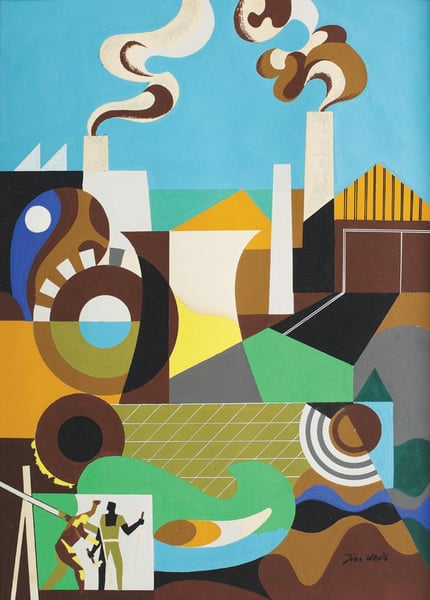
Refinery
Analisi esperta di Refinery di Jean David
Stile: Cubism · Genere: cityscape
Expert Analysis: "Refinery" by Jean David
Within the framework of early 20th-century Cubism, Jean David’s Refinery stands as a compelling and instructive example of how the movement’s formal innovations were applied to the modern industrial cityscape. Unlike the more famous Cubist works focused on still lifes, portraits, or café scenes (Picasso, Braque, Gris), David turns his attention to the gritty, mechanistic heart of the urban periphery—the oil refinery.
Stylistic Significance: The painting operates squarely within the Synthetic Cubist idiom, though with a distinct industrial vernacular. David fractures the refinery’s towers, pipes, and storage tanks into a tapestry of intersecting planes and faceted geometric shards. The composition abandons a single vanishing point in favor of a fragmented, multi-perspectival view: the viewer sees the scaffolding of the refinery from above, below, and sideways simultaneously. This simultanéité—a hallmark of Cubism since the 1910s—serves not merely as a formal exercise but as an attempt to render the visual experience of a sprawling, disorienting industrial landscape. The palette is intentionally muted, leaning on earthy ochres, grays, and muted greens, with occasional flickers of rust-red—colors that evoke the metallic and petroleum-soaked reality of the site. The energy of the work lies in the tension between hard-edged geometric abstraction and the recognizability of the industrial subject.
What Makes It Significant: While Cubism is often celebrated for dissolving the boundaries between figure and ground, David’s Refinery expands that project into the realm of heavy industry—a domain rarely treated with such formal rigor by the movement’s core members. The artwork demonstrates that Cubism was not confined to bohemian interiors but could be a powerful language for representing the machine age. In its synthesis of analytical deconstruction and synthetic compositional unity, Refinery bridges the gap between the early Cubist experiments and the later, more decorative tendencies of the 1920s. It also prefigures the celebration of industrial forms found in Precisionism and even some aspects of Futurism, yet remains distinctly Cubist in its refusal to glorify technology through dynamic lines, instead subjecting it to cool, cerebral geometry. In short, David’s Refinery is significant as a rare and rigorous fusion of Cubist methodology with a modern urban subject, proving that the movement’s radical vision could be applied to the very landscapes of progress and production that were transforming the world.
Visivamente simili
20 opere con composizione e palette affini

The Lights of the Plant
Maria Stolarova

Industrial Landscape
Maria Stolarova

Scherzo (Sonata of the Serpent)
Mikalojus Konstantinas Ciurlionis
Gas Tanks
Bernd and Hilla Becher

Vajda Lajos 1928. Gyárépület. 240x305 Mm Tempera, Pasztell
Vajda Lajos
Gas Plant
Walter Gramatté

Cuando El Cantaro Se Rompe (espacio Post Nuclear)
Martin Pereira
Scheiber Hugó, Esti Fények
Scheiber Hugó

Factory
Spyros Vassiliou
Gasometer in Schöneberg
Ernst Ludwig Kirchner
End of the Parade, Coatesville, Pa.
Charles Demuth
Untitled from the portfolio With the Grain of the Wood (Au fil du bois)
Pierre Alechinsky
Neons for the Reading Power Station
Stephen Antonakos
Landscape with red houses
Oleksandr Bogomazov

DESNUDO SURREALISTA
Maruja Mallo

The Electric State
Simon Stalenhag

The Blue Posts
Patrick Caulfield
Scheiber Hugó Nagyváros
Scheiber Hugó

Továrna
Josef Capek
Mardakan view
Sattar Bahlulzade