
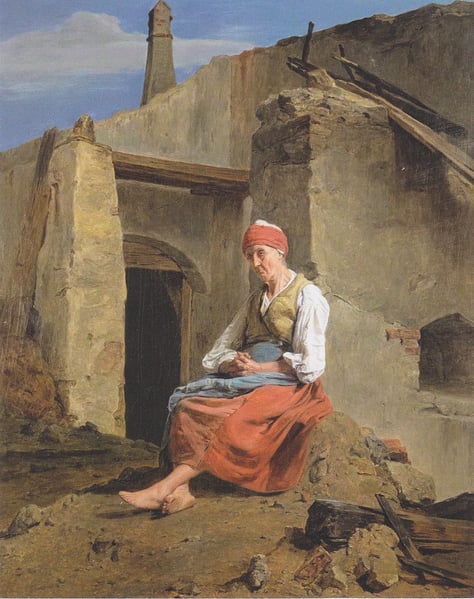
Analisi esperta di At the ruins of the fire di Ferdinand Georg Waldmüller
Stile: Romanticism · Genere: genre painting
Expert Analysis: At the Ruins of the Fire by Ferdinand Georg Waldmüller
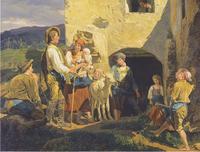
Ferdinand Georg Waldmüller’s At the Ruins of the Fire is a compelling example of Romanticism’s engagement with both nature and human emotion, channeled through the accessible lens of genre painting. While Waldmüller is often associated with the meticulous realism of the Biedermeier period, this work aligns with core Romantic concerns—particularly the sublime experience of decay, transience, and the resilience of life in the aftermath of destruction.
Significance within Romanticism: The painting captures a moment of quiet aftermath: a fire has ravaged a structure, leaving only ruins. Romantic artists frequently used ruins as symbols of the passage of time, the fragility of human endeavor, and the power of nature to reclaim what is built. Waldmüller imbues the scene with a contemplative mood, typical of Romanticism’s fascination with melancholy and the sublime. The smoldering remains and the interplay of light and shadow—likely an early evening or dawn glow—heighten the emotional resonance, inviting viewers to reflect on loss and renewal.
Significance as Genre Painting: As a genre painting, At the Ruins of the Fire elevates an everyday scene—people confronting the aftermath of a disaster—into a universal statement. Waldmüller’s characteristic attention to realistic detail (the texture of charred wood, the clothing of the figures, the vegetation pushing through the rubble) grounds the Romantic symbolism in tangible human experience. This combination of precise observation and emotional depth distinguishes the work. The figures, possibly a family or villagers, are not heroic but quietly resilient, embodying Romanticism’s interest in the dignity of ordinary life.
Artistic Merit: Waldmüller’s mastery of light and atmosphere—a hallmark of his style—gives the scene a luminous quality that softens the tragedy. The ruins are not merely picturesque; they serve as a moral and emotional touchstone. The painting thus bridges two Romantic impulses: the love of unspoiled nature and the recognition of human struggle within it. In doing so, At the Ruins of the Fire stands as a poignant meditation on destruction and survival, capturing a fleeting moment of contemplation that resonates far beyond its genre confines.
Visivamente simili
20 opere con composizione e palette affini
The spinner
Vincenzo Cabianca
Swineherdess
Cristiano Banti
Meeting of peasant women
Cristiano Banti
The surprise
Alexandre Antigna

The new material
Jules Trayer
Dutch girl
Henry Mosler

Play Time
Giovanni Battista Torriglia
Courtship
Gerolamo Induno
Woman Carrying Firewood and a Pail
Jean-Francois Millet

Good News
Eugene de Blaas
Rest for the weary
Alexandre Antigna
H0014 L04615346
Antonio Zoppi
A New Hat
Wenzel Tornøe
The overturned doll's pram
Felix Schlesinger

Repairing Lesson
Jules Trayer

Vor dem Schulweg
Johann Friedrich Treml
The bailout
Ferdinand Georg Waldmüller
Le virtu di fido
Giuseppe Costantini
Der Brief
Berthold Woltze
The good mother (The spinning wheel)
Noè Bordignon