Expert analysis of Norman Bluhm’s Eudocia
Style: Abstract Expressionism · Genre: abstract
Expert Analysis: "Eudocia" by Norman Bluhm
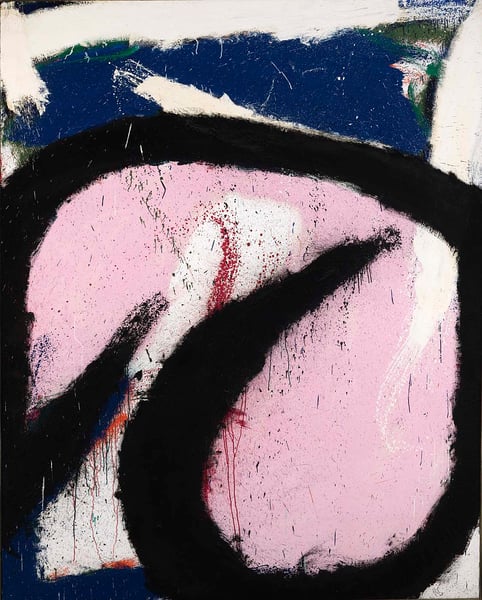
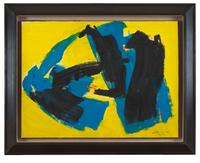
Norman Bluhm’s Eudocia stands as a compelling testament to the second generation of Abstract Expressionism, a movement that sought to channel raw emotion and existential energy through non-representational means. As an abstract work within this style, the painting is significant for how it simultaneously embraces the core tenets of the New York School—gestural spontaneity, monumental scale, and a visceral physicality—while also introducing a distinctively lyrical and culturally allusive sensibility.
Significance within Abstract Expressionism:
-
Bluhm’s Unique Position: Bluhm emerged in the 1950s alongside peers like Joan Mitchell and Sam Francis, yet he maintained a singular voice. His time in Paris (before joining the New York School) immersed him in both European modernist tradition and the art informel movement, infusing his Abstract Expressionist work with a refined, almost calligraphic elegance. Eudocia embodies this fusion: it retains the aggressive, dripping gestures of Pollock and de Kooning but refines them into a more controlled, rhythmic dance of color and line.
-
Literary and Classical Allusion: The title “Eudocia” references a Byzantine empress and poet—a deliberate departure from the purely abstract, non-referential titling common in earlier Abstract Expressionism (e.g., Number 1, Lavender Mist). By naming the work, Bluhm invites a tension between pure abstraction and narrative resonance. This move anticipates the later shift toward "lyrical abstraction" and "color field" painting, where titles often carry poetic or historical weight. Eudocia thus marks a moment when Abstract Expressionism began to incorporate external cultural references without sacrificing its core non-objective vocabulary.
-
Formal Innovations: Bluhm’s technique in works like Eudocia is notable for its fluid, sweeping brushstrokes set against fields of intense color. He often allowed paint to drip and pool, yet maintained a sense of elegant composition—a balancing act between chaos and control. This places him alongside artists who pushed Abstract Expressionism beyond its initial "heroic" phase toward a more decorative or embodied expressiveness, influencing the development of Post-Painterly Abstraction.
Conclusion: Eudocia is significant because it exemplifies the evolution of Abstract Expressionism in the mid-20th century: a movement that began as a raw, psychological outburst and matured into a sophisticated, globally aware dialogue between gesture, color, and narrative allusion. Norman Bluhm’s work here is a bridge—anchored in the gestural freedom of the New York School, yet reaching toward the intellectually layered, culturally resonant abstraction that would define later American art.
Visually similar
20 works with related composition and palette
Mathematics
Norman Bluhm
Untitled
Norman Bluhm
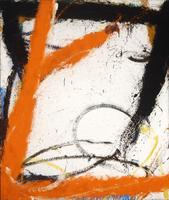
Waterloo
Norman Bluhm
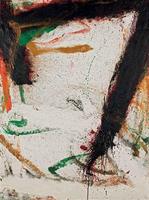
Gronk!
Norman Bluhm
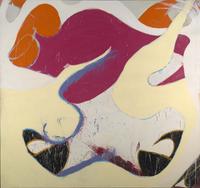
Dido
Norman Bluhm
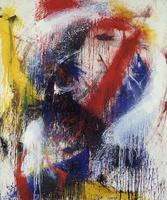
Excalibur
Norman Bluhm
Untitled
Helen Frankenthaler

Fictitious Blank #2841W20
SHIH,SIAO-MO
Itazura Ni
Kazuo Shiraga
Untitled
Jiro Yoshihara
Dhatri II
Norman Bluhm
Untitled
Norman Bluhm
Round About
Norman Bluhm
Untitled
Sofia Areal
Il torneo a Valencia
Antonio Corpora
Fictitious Blank #2841W1
SHIH,SIAO-MO
Untitled
Antonio Corpora
Så kan det bli
Rune Jansson
Karant 5.7.1957
Karl Otto Gotz
Abstract Composition
Gerard Schneider