Expert analysis of Albert Gleizes’s Acrobats
Style: Analytical Cubism · Genre: genre painting
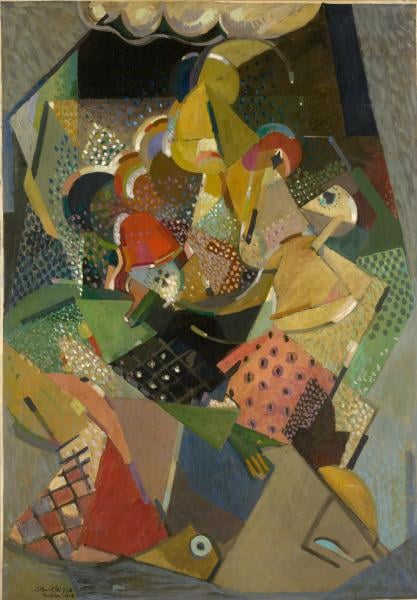
Albert Gleizes' Acrobats is a quintessential example of Analytical Cubism applied to the genre painting tradition, marking a significant moment in the movement's evolution from still life to the human figure in motion. Within the period of Analytical Cubism (circa 1909–1912), artists such as Gleizes sought to deconstruct objects and figures into geometric facets, presenting multiple viewpoints simultaneously while reducing color to a near-monochromatic palette in order to emphasize structure over sensation.
What makes Acrobats particularly significant is its subject: performers caught in the midst of a physical act. Unlike Picasso and Braque, who typically confined Analytical Cubism to still lifes or portraits, Gleizes—a leading theorist and co-author of the seminal 1912 text Du Cubisme—applied the rigorous fragmentation of form to a dynamic, narrative scene. The acrobats’ bodies are not merely dissected; their contortions and interactions are rendered through intersecting planes and shifting perspectives, capturing both the fluidity of their movements and the solidity of their forms. This synthesis of analytical dissection and human vitality exemplifies how Gleizes pushed Cubist principles into the realm of genre painting, treating everyday spectacle with the same intellectual structure reserved for static objects.
Furthermore, the work underscores Gleizes’ commitment to the Cubist goal of representing an object’s totality—its spatial and temporal reality—rather than a single optical impression. In Acrobats, the performers are shown from multiple angles at once, their limbs and torsos overlapping in a geometric rhythm that mirrors the grace and tension of their act. The restrained palette of ochres, grays, and muted blues focuses attention on the interplay of lines and volumes, while the subject matter—performers at the margins of society—adds a layer of humanistic observation uncommon in the more hermetic works of early Cubism.
Ultimately, Acrobats stands as a key bridge between the austere experimentation of early Analytical Cubism and the more expansive, figurative applications that would follow. It demonstrates that the Cubist method could be applied not only to objects but to the very experience of motion, performance, and social life, cementing Gleizes’ role in broadening the movement’s thematic and formal ambitions.
Genre
Style
Visually similar
20 works with related composition and palette
A Black Pedestal
Georges Braque
Berlini Kabaré
Bela Kadar
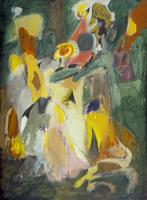
Waterfall
Arshile Gorky
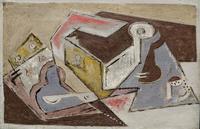
Naturaleza Muerta Con Tijeras
Maria Blanchard
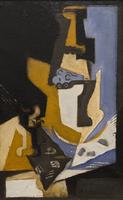
Bodegón
Maria Blanchard
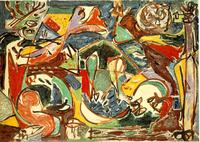
The key
Jackson Pollock
Golden Brown Painting
Arshile Gorky
Jardin des êtres
Asger Jorn
I gatuvimlet
Gosta Adrian-Nilsson
Woman with umbrella. The Parisian
Robert Delaunay
Las Meninas (Velazquez)
Pablo Picasso
Asklepois
Hans Hofmann
Femme au Fauteuil
Albert Gleizes
Sereia
Joaquim Rodrigo
Untitled
James Brooks
Moon Woman
Jackson Pollock
L’Atelier sur la terrasse de Mirmande
André Lhote
Jeux des formes
Serge Brignoni
From Thoughts of Alchemy
Boris Margo
Untitled
Andre Lanskoy