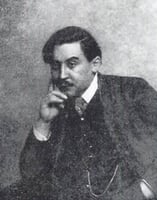
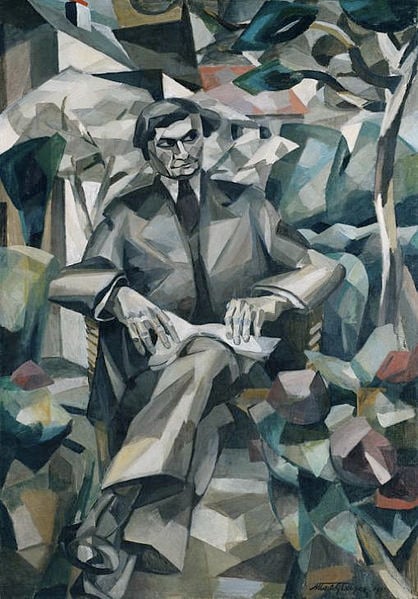
Analisi esperta di Portrait de Jacques Nayral di Albert Gleizes
Stile: Cubism · Genere: portrait
Expert Analysis of "Portrait de Jacques Nayral" by Albert Gleizes
This portrait, executed in 1911 by the French artist and theorist Albert Gleizes, stands as a pivotal work within the development of Cubism, particularly in its application to the traditionally intimate genre of portraiture. Gleizes, a central figure in the Salon Cubists, here demonstrates the movement's ambition to move beyond still-life and landscape subjects, tackling the human face and figure with the same radical formal vocabulary.
Significance within Cubism and the Portrait Genre
-
Breaking the Conventions of Portraiture: Traditional portraiture sought to capture likeness, personality, and social status through naturalistic representation. Gleizes, by contrast, dismantles the sitter—the writer and critic Jacques Nayral—into a system of interlocking geometric planes and faceted surfaces. The face is not a window to the soul but a composite of angles, with the nose, eyes, and brow rendered as overlapping, translucent volumes. This approach rejects Renaissance perspective and psychological depth in favor of a new kind of conceptual truth.
-
The Figure as a Construct of Space and Time: Gleizes synthesizes multiple viewpoints into a single image. The viewer sees Nayral from the front, profile, and perhaps even from above, simultaneously. This is a hallmark of Analytical Cubism, but Gleizes applies it with a particular coherence, integrating the sitter’s form with the surrounding background. The subject does not sit in space; he is part of it. The planes of the jacket, the books, the table, and the wall all share the same fractured, crystalline logic. This fusion of figure and ground reflects the Cubist belief that reality is not static but a dynamic, continuous field of perception.
-
Gleizes’s Theoretical Contribution: This work is significant not only for its visual power but also for its role in the theoretical evolution of Cubism. Gleizes, along with Jean Metzinger, would publish Du Cubisme (1912), one of the movement’s foundational texts. In this portrait, we see the principles he would codify: the rejection of a single fixed viewpoint, the use of geometry to reveal the “essential” form of the subject, and the integration of the sitter’s psychological presence through abstract means rather than expression. The portrait is not a copy of Nayral’s appearance but a constructed equivalent of his identity—intellectual, modern, and complex.
-
Placement in Cubist History: While Picasso and Braque were developing a more hermetic, monochromatic Cubism in their Paris studios, Gleizes and the Salon Cubists (including Léger, Delaunay, and Le Fauconnier) brought these ideas to a larger public. This portrait, with its luminous palette of ochres, browns, and grays punctuated by areas of brighter color, shows a transitional phase between the still-life emphasis of early Cubism and the more dynamic, synthetic phase to come. It is a statement that Cubism could be a humanistic, expansive language, not just a narrow formal experiment.
In summary, Portrait de Jacques Nayral is significant because it demonstrates the audacity of Cubism applied to the human face, transforms the portrait from a likeness into a conceptual structure, and embodies the theoretical ambitions of one of the movement’s key advocates. It remains a landmark in the history of modern portraiture, showing how abstraction can serve—rather than destroy—the representation of a person.
Visivamente simili
20 opere con composizione e palette affini
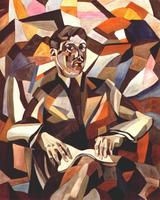
Self-portrait
Aristarkh Lentulov
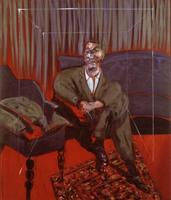
Seated Figure
Francis Bacon
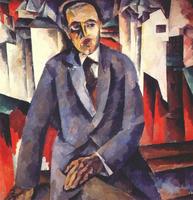
Portrait of the Regisseur Alexander Tairov
Aristarkh Lentulov
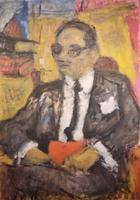
Férfi Portré
Bela Czobel
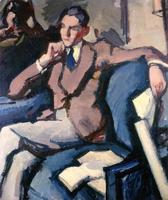
Willy Peploe
Samuel Peploe
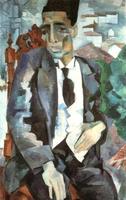
Portrait of Midkhad Refatov
Robert Falk
The Art Dealer Guido Arnot
Egon Schiele
Self-Portrait in Blue Jacket
Max Beckmann
Harold Rosenberg
Elaine de Kooning
Thomas B. Hess
Elaine de Kooning
Portrait of Art Dealer Manfred Shames
Ernst Ludwig Kirchner
A Man in Melancholy
Zeng Fanzhi
Paul Leclercq
Henri de Toulouse-Lautrec
The Big Man
Lucian Freud
Man in a Chair
Lucian Freud
Professor Corbetta
Varlin
Diego Seated
Alberto Giacometti
Mihály Károlyi
Bertalan Por
Man in a String Chair
Lucian Freud
John F. Kennedy
Elaine de Kooning