Expertenanalyse zu Robert Williamss Timmy's Last Surprise
Stil: Lowbrow Art · Genre: figurative
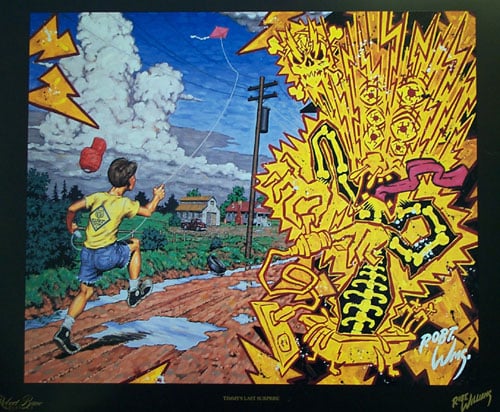
Expert Analysis: “Timmy’s Last Surprise” by Robert Williams
Robert Williams is a foundational figure in Lowbrow Art, a movement that emerged from the fringes of 1960s and 70s underground comix, hot rod culture, and punk aesthetics. “Timmy’s Last Surprise” exemplifies the core tenets of the genre: narrative-driven figurative painting infused with dark humor, technical precision, and a subversive twist on American popular culture.
Composition and Technique
Executed with rigorous academic draftsmanship—a hallmark of Williams’s work—the piece uses classical oil painting techniques to render hyper-detailed, often grotesque figures. The figurative style is deliberate: cartoonish proportions collide with realistic textures (flesh, fabric, mechanical parts), creating an unsettling visual tension. This contrast is central to Lowbrow’s challenge to the divide between “high” and “low” art.
Narrative and Symbolism
The title, “Timmy’s Last Surprise,” suggests a climactic moment within a pulp-fiction-like story. Williams frequently employs childlike protagonists in adult, macabre scenarios. Here, “Timmy” likely faces an ironic or violent punchline—a “surprise” that subverts innocence. Expect iconography cribbed from vintage advertisements, carnival sideshows, and B-movies: distorted anatomical forms, absurd machinery, or surreal landscapes. This layering of nostalgic Americana with transgressive content is what makes Lowbrow a critique of suburban conformity and consumerist kitsch.
Significance within Lowbrow Art
“Timmy’s Last Surprise” is significant because it embodies Williams’s role as the “godfather of Lowbrow.” He transformed underground comix’s raw, anti-establishment energy into gallery-worthy paintings that retain their populist, irreverent core. The work stands as a manifesto: fine art can be visceral, funny, and deliberately “low” in subject while achieving high-level craft. It also reflects the movement’s debt to Surrealism (particularly Dalí’s meticulous distortion) and Pop Art’s embrace of commercial imagery—but with a darker, more anarchic edge.
Impact
By the 1990s, Lowbrow gained legitimacy through figures like Williams, who co-founded Juxtapoz magazine. “Timmy’s Last Surprise” would be a prime example of how the genre bridges underground subcultures (hot rod, tattoo, skate) and the contemporary art world, challenging elitist boundaries. Its narrative ambiguity and masterful execution make it a touchstone for understanding Lowbrow’s ongoing influence on illustration, street art, and visual storytelling.
Visuell ähnlich
20 Werke mit ähnlicher Komposition und Farbpalette
Nine Indo Nostril Pickineers
Robert Williams
Runaway Imagination on the Back of a Wild Mare
Robert Williams
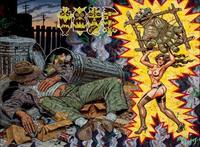
The Flotsam Dilettante and the Little Visitation That Only a Derelic Could Understand
Robert Williams
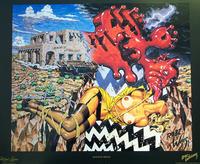
Ranch of Disease
Robert Williams
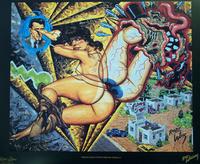
Mirror Image with Varicose Eyeballs
Robert Williams
Cafe Deutschland
Jorg Immendorff
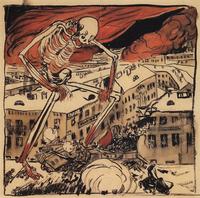
Introduction. Picture from the magazine Vampire
Boris Kustodiev
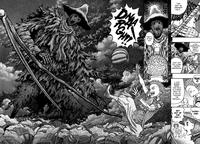
Berserk Ink Art
Kentaro Miura
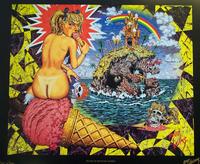
Island of Infantile Avarice
Robert Williams
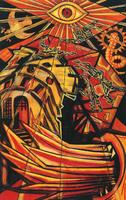
Thoth Tarot
Lady Frieda Harris
Baranquilla
Alejandro Obregon
Santa Cruz Skateboards
Robert Williams
Moscow. Introduction. Picture from the magazine Vampire
Boris Kustodiev
Untitled
Ligia Macovei
Brother.
Erro
Lift.Tremble.Back
Jorg Immendorff
Suicide
Sue Coe
Monuments and Observers
Vladimir Kolosov
Juanito Laguna Remontando Un Barrilete
Antonio Berni
The Op Tattoo
Robert Williams