
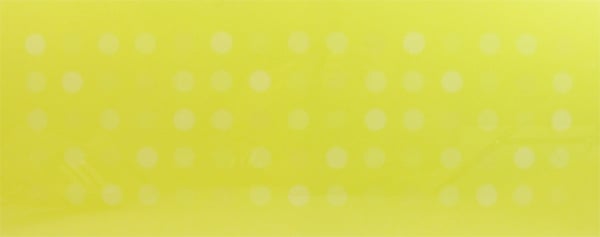
Analisi esperta di Grid Forty di Thomas Downing
Stile: Op Art · Genere: abstract
Expert Analysis: "Grid Forty" by Thomas Downing
Thomas Downing’s Grid Forty is a quintessential work of Op Art (Optical Art) that crystallizes the movement’s core ambition: to generate visual sensation through rigorous, systematic abstraction. As a pure abstract, the painting forgoes narrative or representational content, instead relying entirely on the structured interplay of color and geometry to produce perceptual instability.
Significance within Op Art
- Systematic Repetition and Optical Vibration: The painting’s title explicitly highlights its underlying structure—a grid. In Grid Forty, Downing likely employs a regular, modular grid of uniform cells (a hallmark of his mature style). This orderly repetition is not static; when filled with carefully chosen, high-chroma hues (often from the Washington Color School palette), the adjacent colors create retinal fizzing, afterimages, and a sense of movement. This aligns perfectly with Op Art’s goal of engaging the viewer’s eye dynamically, making the painting “active” rather than passive.
- Color as both Form and Phenomenon: As an Op Art piece, Grid Forty treats color not as decoration but as the primary agent of optical effect. Downing’s grids often use color sequences or contrasts (e.g., warm/cool, complementary pairs) that push and pull against the rigid geometry. The result is a tension between the known stability of the grid and the lived instability of color perception—a central concern of Op Art artists like Bridget Riley and Victor Vasarely.
- Minimal Means, Maximal Experience: The work’s abstract nature reduces imagery to its bare essentials: a repeated shape (the square grid) and pure color. Yet this minimal vocabulary produces a rich, almost disorienting sensory experience. The significance lies in how Downing proves that conceptual simplicity can yield perceptual complexity—a key legacy of both Op Art and the broader Minimalist tendencies of the 1960s.
In summary, Grid Forty is significant because it demonstrates Op Art’s power to transform a neutral, mathematical structure into a living, flickering field of color. The work stands as an exemplar of how systematic abstraction can directly stimulate the human visual system, making the act of seeing itself the subject of the art.
Visivamente simili
20 opere con composizione e palette affini

Grid Twenty-Eight
Thomas Downing
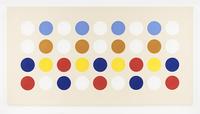
Grid #9: Saranac
Thomas Downing
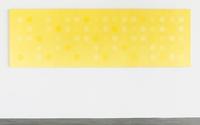
Grid Twenty-Nine
Thomas Downing
Untitled
Kuno Gonschior
No. 26
Jeremy Moon
Black Dahlia
Gene Davis
Ovali
Turi Simeti
From Line
Lee Ufan
Untitled
Sohrab Sepehri
Entladung Et I
Gunter Fruhtrunk
Untitled Circle Painting: 12 multicoloured panels, no.1
Ian Davenport
Forme ovali al negativo
Turi Simeti
Untitled
Marcelle Cahn
Moving Circles
Sophie Taeuber-Arp
Phased Red
Thomas Downing
Silver Series
Paul Brach
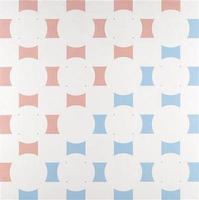
Induzione cromatica (bianco, rosato, azzurrato) e formale (stratificazione alternante dischi e quadri in primo piano)
Mario Ballocco
Print 9
Bernard Cohen

The Negative Way #7
Paul Brach
Untitled
Yuri Zlotnikov