
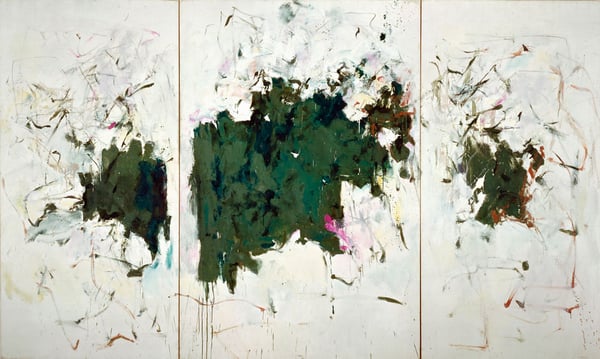
Expert analysis of Joan Mitchell’s Girolata Triptych
Style: Abstract Expressionism · Genre: abstract
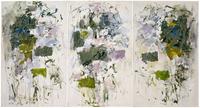
The "Girolata Triptych" (circa early 1960s) by Joan Mitchell is a landmark work from her Early Career France: 1958–1968 period, a transitional phase during which the artist established her mature voice in Abstract Expressionism. The painting is significant not only as a prime example of second-generation Abstract Expressionism but also for how it redefines the movement’s conventions through structure, color, and emotional geography.
Significance within Abstract Expressionism:
Mitchell was among the few female artists to achieve critical recognition within the male-dominated New York School. In the "Girolata Triptych," she demonstrates a masterful departure from the all-over, fully improvisational "action painting" of first-generation figures like Jackson Pollock or Willem de Kooning. Instead, she imposes a triptych format—a deliberate, architectural structure traditionally associated with religious altarpieces—onto the raw energy of gestural abstraction. This fusion of classical composition with explosive brushwork is a key innovation: the three panels create a rhythmic, panoramic space that forces the viewer to read the painting sequentially, from left to right, as a narrative of natural sensation.
The work is named after the coastal village of Girolata in Corsica, reflecting Mitchell’s lifelong practice of anchoring abstract imagery in remembered landscapes. During her early years in France (where she had moved in 1959), she increasingly translated the physical experience of light, water, and wind into pure painterly marks. In this triptych, the chromatic intensity—vivid blues, greens, and sun-blasted yellows clashing with slashing black or grey strokes—does not illustrate a view; rather, it embodies the sensation of the Mediterranean terrain. The brushwork is both violent and lyrical: broad, sweeping arcs collide with dense, knotted dabs, capturing the interplay of calm and turbulence.
Why it matters:
- Expansion of Abstract Expressionist vocabulary: Mitchell proves that abstraction can be deeply personal and representational without imitating nature. The triptych format allows her to explore time and movement—the left and right panels often act as "breathing" wings that frame a more turbulent center.
- Feminine and formal authority: At a time when Abstract Expressionism was often coded as masculine (heroic, aggressive), Mitchell’s work asserts a different kind of power—one rooted in sensory memory, exacting draftsmanship, and the confidence to use delicate pinks or lemon yellows alongside raw slashes of paint.
- Bridge to Color Field and Lyrical Abstraction: By emphasizing saturated color and emotional atmosphere over pure gesture, the "Girolata Triptych" foreshadows later developments in 1960s post-painterly abstraction, while still retaining the visceral, physical immediacy that defines Abstract Expressionism.
In sum, the "Girolata Triptych" is a quintessential work of Mitchell’s early French period: a synthesis of European landscape tradition, American gestural freedom, and a uniquely personal sense of form. It stands as a testament to her ability to make abstraction feel both monumental and intimate.
Visually similar
20 works with related composition and palette
La Vie en Rose
Joan Mitchell
Salut Tom
Joan Mitchell
Dibirdibi Country
Sally Gabori
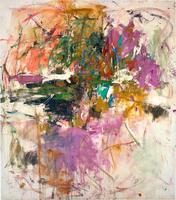
Untitled
Joan Mitchell
Dibirdibi Country
Sally Gabori
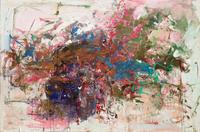
Grandes Carrières
Joan Mitchell
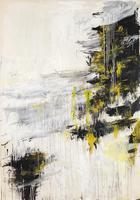
Quattro Stagioni II. Inverno
Cy Twombly
Embullient Chord
Peter Busa
6 Works: Wildflower Dreaming: Dry Season
Emily Kame Kngwarreye
Mislead
Nemanja Vučković
Untitled
Adnan Coker
1947-R-No. 1
Clyfford Still
Sacrifice 1.
Ben Vollers
Trees
Joan Mitchell
Untitled
Joan Mitchell
Untitled
Joan Mitchell
Le Chemin des Ecoliers
Joan Mitchell
Girolata
Joan Mitchell
Merci
Joan Mitchell
Untitled
Jaroslav Serpan