
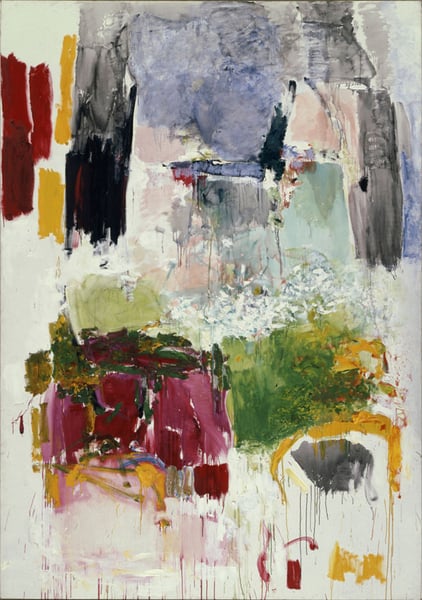
Expert analysis of Joan Mitchell’s Low Water
Style: Abstract Expressionism · Genre: abstract
Expert Analysis of "Low Water" by Joan Mitchell (c. 1960s)
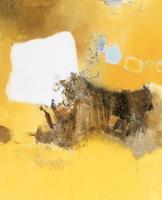
Joan Mitchell’s Low Water is a compelling example of her mature Abstract Expressionist practice during her early career in France (1958–1968), a period defined by a decisive shift toward a more lyrical, light-infused abstraction rooted in the natural world. While the work remains resolutely non-representational, its title and composition evoke the physical sensation of a riverbed at ebb—a motif that recurs in Mitchell’s oeuvre as a metaphor for memory, flux, and the act of painting itself.
Significance within Abstract Expressionism
Mitchell was a leading second-generation Abstract Expressionist, but she diverged from the heroic, masculine scale and psychic turmoil of her American predecessors (Pollock, de Kooning). Instead, her work from this French period foregrounds a nuanced, almost Impressionist sensitivity to atmosphere and color. Low Water exemplifies this departure: broad, sweeping strokes of translucent blues, greens, and earthy ochres interweave with aggressive dabs of white and black, suggesting both the movement of water and the harsh light of a dry season. The painting balances vigorous gesture with a sense of restraint—the “low” of the title implies absence, a quiet tension between fullness and depletion.
Technique and Materiality
Mitchell worked rapidly, often layering oil paint in thin washes and thick impasto simultaneously. In Low Water, patches of bare canvas or thinned pigment create a luminosity that rivals stained canvas techniques (e.g., Helen Frankenthaler), but Mitchell’s hand remains emphatically tactile. The diagonal rush of a dark blue stroke cuts across the lower half, anchoring the composition while the upper registers dissolve into nearly airy, blurred marks. This tension between controlled structure and spontaneous release is a hallmark of her French period.
Context and Legacy
Created after Mitchell’s relocation to the French countryside (Vétheuil, near Monet’s former home), Low Water reflects her ongoing dialogue with nature—not as a subject to be transcribed, but as a source of emotional and physical energy. The work is significant because it bridges American action painting with European post-war lyrical abstraction, proving that Abstract Expressionism could evolve beyond New York’s studio walls. Mitchell’s ability to evoke a specific, embodied experience of landscape—here, the sensation of water receding, of land exposed—without recourse to figuration cements her as a pivotal figure in the movement’s expansion toward ecological and sensuous abstraction.
In summary, Low Water is not merely an abstract composition; it is a record of Mitchell’s sustained inquiry into how paint can hold the memory of light, weather, and the body’s encounter with place. Its significance lies in its synthesis of aggressive gesture and atmospheric clarity, asserting a distinctly feminine, nature-infused voice within the male-dominated canon of Abstract Expressionism.
Genre
Visually similar
20 works with related composition and palette
Mooring
Joan Mitchell
The Lot
Joan Mitchell
Sommitelma
Tove Jansson
Untitled
Joan Mitchell
Untitled
Joan Mitchell
Art Like Love Is Dedication
Hans Hofmann
Sera Romana
Giuseppe Santomaso
Sacrifice 1.
Ben Vollers
Wild Vine
Hans Hofmann
Oisin's Dream
Mary Abbott
Abstraction (Rupture)
Alexander Rodchenko
Sunflower III
Joan Mitchell
Figure
Afro
Untitled I
Willem de Kooning
Nulli Secundus
Hans Hofmann
Composition with Black
Alexander Bogen
C and O
Franz Kline
No.1 (Untitled)
Mark Rothko
Untitled
Joan Mitchell
Dourado No. 34
Manabu Mabe