
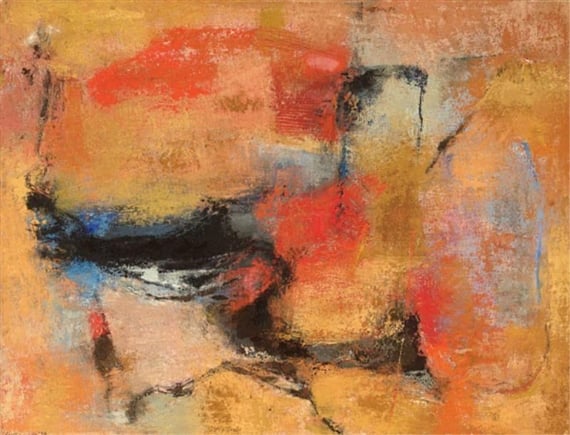
Análisis experto de Sera Romana de Giuseppe Santomaso
Estilo: Art Informel · Género: abstract
Expert Analysis of “Sera Romana” by Giuseppe Santomaso (Art Informel) – Abstract Genre
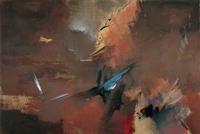
Giuseppe Santomaso’s “Sera Romana” (Roman Evening) stands as a compelling testament to the European post-war sensibility of Art Informel, a movement that rejected geometric abstraction in favor of spontaneous, gestural, and material-driven expression. The work’s significance lies in how Santomaso infuses the informal, anti-compositional language of Informel with a distinctly Mediterranean luminosity and spatial poetry—a fusion that sets him apart from his French and American contemporaries.
Within the context of Art Informel, Santomaso avoided the raw, often aggressive mark-making of artists like Jean Fautrier or Wols. Instead, “Sera Romana” exemplifies a lyrical, atmospheric variant of the style. The title evokes a specific place and time of day—a Roman evening—yet the painting is fully abstract. This tension is key: Santomaso does not depict the city but translates its sensory essence (warm light, ancient stone, twilight air) into fluid, translucent veils of color and calligraphic gestures. The work’s significance can be broken down into three core aspects:
-
Chromatic Atmosphere over Form – Typical of Art Informel, form dissolves, but here it is replaced not by chaos but by a luminous, almost watercolor-like wash. Santomaso layers muted earth tones and soft ochres against diaphanous blues and grays, suggesting the fading light of a Roman sunset. This coloristic subtlety connects his practice to the Venetian tradition of colorito, while the sheer, unprimed canvas absorbs pigment like fresco—a nod to Italy’s artistic heritage.
-
Gestural Freedom with Restraint – The “informe” (formlessness) is tempered by Santomaso’s controlled lyricism. Quick, fluid strokes and drips (reminiscent of Jackson Pollock’s influence but Europeanized) are balanced by areas of quiet, stained cloth. This duality—spontaneity and meditation—makes “Sera Romana” a bridge between Abstract Expressionism’s exuberance and the more contemplative European tachisme. The significance here is Santomaso’s ability to make gestural painting feel hushed and intimate.
-
Integration of Spatialism and Informel – Santomaso was closely associated with Lucio Fontana’s Spatialism, which sought to unify art, space, and time. In “Sera Romana”, this manifests as an illusion of depth without perspective. The canvas breathes: warm “marks” seem to float in a shallow, misty field, evoking the atmospheric compression of a Roman alley at dusk. The work thus becomes a record of a moment—the act of perceiving light and memory—rather than a static image.
Why It Matters – “Sera Romana” is significant because it demonstrates that Art Informel could be both deeply personal and culturally rooted. Santomaso rejects the existential angst of some Northern European Informel, offering instead a sensuous, humanist alternative. The painting stands as a lyrical high point of Italian post-war abstraction, proving that the informal could be meditative, luminous, and tied to the poetics of place. Its abstraction is not escape but a deeper seeing—a Roman evening distilled into pure painterly sensation.
Visualmente similares
20 obras con composición y paleta relacionadas
Figure
Afro
Mooring
Joan Mitchell
Secret Life (Vita Segreta)
Giuseppe Santomaso
Low Water
Joan Mitchell
Copla
Esteban Vicente
Sacrifice 1.
Ben Vollers
Untitled
Mark Rothko
Il pendolo
Afro
Composition
Afro
Dourado No. 34
Manabu Mabe
La clessidra
Afro
Untitled
Joan Mitchell
The Lot
Joan Mitchell
Après la pluie
Albert Bitran
Untitled
Luis Feito
Sommitelma
Tove Jansson
Untitled
Mark Rothko
Procreation
Nemanja Vučković
Abstraction (Rupture)
Alexander Rodchenko
Alchemie
Jean Miotte