Pierre Alechinsky sanatçısının Linolog I eseri hakkında uzman analizi
Tarz: Neo-Expressionism · Tür: figurative
Expert Analysis: "Linolog I" by Pierre Alechinsky
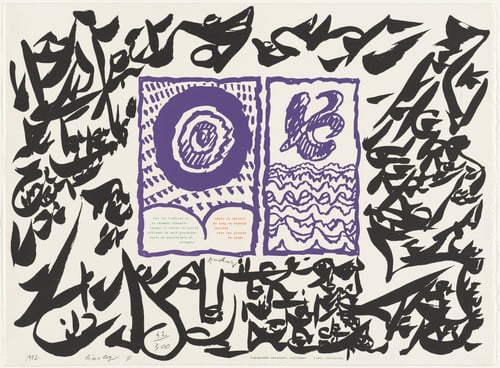
Pierre Alechinsky’s “Linolog I” stands as a compelling exemplar within the Neo-Expressionist movement, particularly in its figurative mode. The artwork’s significance lies in its synthesis of raw emotional energy and a reinvigorated approach to the human or quasi-human form—a hallmark of Neo-Expressionism’s reaction against the austerity of earlier minimalist and conceptual art.
The piece clearly employs the characteristic Neo-Expressionist vocabulary: vigorous, almost calligraphic linework, a loose yet deliberate handling of the figure, and an overall sense of immediacy and psychological intensity. As a figurative work, “Linolog I” does not aim for naturalistic representation but instead distorts and exaggerates its subject to convey inner states—whether anxiety, dynamism, or primal energy. This aligns with the movement’s broader return to narrative and emotion, often rendered through bold, gestural marks and a palette that feels both spontaneous and calculated.
What makes “Linolog I” particularly noteworthy is how it bridges Alechinsky’s earlier affiliations with the CoBrA group (known for spontaneous, childlike figuration) and the later global surge of Neo-Expressionism. The “Linolog” series itself suggests a conceptual interplay between linear drawing (“line”) and a kind of chronicle or register (“log”), hinting at a narrative or sequential quality within a single, compressed image. In this work, the line is not merely descriptive but becomes an independent expressive force—snaking, darting, and coiling around the figure to create a dense, almost calligraphic texture that feels simultaneously ancient and urgently contemporary.
Within the Neo-Expressionist canon, “Linolog I” affirms that figurative painting can be both intellectually rigorous and viscerally potent. It resists easy legibility, demanding that the viewer engage with the tension between form and energy, between the recognizability of the figure and its radical deformation. This is the very power of Neo-Expressionism at its best: a return to the human subject that refuses to sentimentalize, instead presenting it as a site of conflict, flux, and raw presence. Alechinsky’s contribution in this work underscores that the movement was not simply a revival of earlier expressionism but a distinct reimagining of painterly gesture and psychological depth through the lens of modern abstraction.
Görsel olarak benzer
İlişkili kompozisyon ve renk paletine sahip 20 eser
Symbol 61-1
Maki Haku
Rettangolo rosso
Carla Accardi
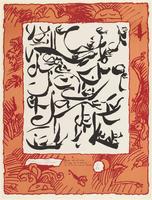
Illuminated Page (Feuille orée)
Pierre Alechinsky
Untitled
Lee Krasner
Nero
Carla Accardi
May 26th Backwards
Helen Frankenthaler
Lutins au Printemps
Willi Baumeister
Landscape
Adja Yunkers
Seismographic Brew (Brassée sismographique)
Pierre Alechinsky
Untitled (number drawing)
Craig Kauffman
The Red Sun Gnaws at the Spider
Joan Miro
Amsterdam
Pierre Alechinsky
Complicated Network
Antonio Sanfilippo
Drava Expression No.3
Alfred Freddy Krupa
Untitled
Joan Miro
Untitled
Keith Haring
Personnages colorés
Charles Lapicque
Poem 68-44
Maki Haku
Music to Be Seen (Open Edge Series)
Ulfert Wilke
Ancient Dances
Dave Holt