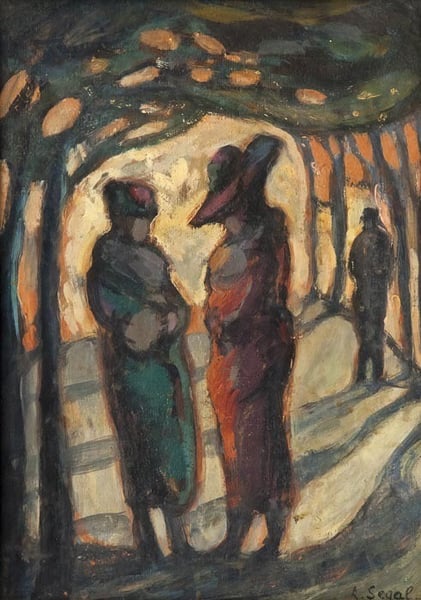
Figures in a wooded park
Analisi esperta di Figures in a wooded park di Arthur Segal
Stile: Impressionism · Genere: genre painting
Expert Analysis of "Figures in a wooded park" by Arthur Segal
Arthur Segal’s Figures in a wooded park is a notable example of Impressionist genre painting, though its significance lies in how Segal adapts the core principles of the movement to a subject rooted in everyday leisure. Painted during a period when Impressionism was already well established, the work demonstrates Segal’s commitment to capturing transient light and atmosphere while focusing on the figure as part of a natural, lived-in environment.
Stylistic Significance As an Impressionist work, the painting embodies the movement’s signature techniques: loose, visible brushstrokes, a bright palette, and an emphasis on the shifting effects of sunlight filtering through dense foliage. Segal treats the “wooded park” setting as a stage for perceptual experimentation—dappled light breaks across figures and trees, dissolving crisp outlines into shimmering patches of color. This approach aligns with the Impressionist goal of recording a fleeting moment, particularly the interplay between shadow and light in a natural setting.
Genre Painting within Impressionism The work’s genre—depicting everyday figures in a park—was a hallmark of Impressionism, which elevated scenes of modern bourgeois leisure (picnics, strolls, garden parties) to the level of high art. Figures in a wooded park participates in this tradition: anonymous men, women, and possibly children are shown at ease, blending into the landscape rather than dominating it. This integration of human activity with the natural world reinforces the Impressionist belief that modern life and nature are inseparable. The figures are not individual portraits but types, emphasizing the universal experience of relaxation in a public green space.
Context within Segal’s Career Arthur Segal is often associated with later Expressionist and Dadaist movements, making his Impressionist phase particularly significant as a foundation. Figures in a wooded park captures him at a moment when he was fully engaging with the Impressionist lexicon—prior to his later more radical stylistic shifts. This painting thus serves as a document of his early commitment to capturing sensory immediacy and atmospheric truth, hallmarks he would later subvert in his more abstract and political works.
Why It Matters Within Impressionism, Figures in a wooded park stands out for its balanced composition: the vertical tree trunks create a rhythmic frame around the figures, while the open sky above (likely suggested) provides a cool counterpoint to the warm greens and earth tones. It exemplifies how Impressionism could render the ordinary—a stroll in a park—as a poetic, luminous event, while also showcasing Segal’s skill in orchestrating light and form before his stylistic evolution. The work is a testament to the movement’s enduring power to find beauty in the mundane, filtered through the artist’s unique sensibility.
Genere
Stile
Visivamente simili
20 opere con composizione e palette affini
Night on the Outskirts of Town
Istvan Farkas
Sunny way
August Macke
Woman in a Green Jacket
August Macke
Children and sunny trees
August Macke
Women on the Street
Ernst Ludwig Kirchner
Woman with a Yellow Jacket
August Macke
Province
Kazimir Malevich
Woman in park
August Macke
Spots of Sunlight on the Terrace
Maurice Denis
Untitled
Julio Resende
People at the blue lake
August Macke
Couple on the Shore (from the Reinhardt Frieze)
Edvard Munch
Evening
Grigoriy Goldstein
Parkway
August Macke
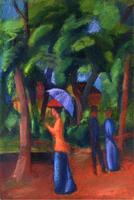
Walking in the Park
August Macke
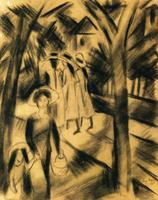
Woman with Child and Girls on a Road
August Macke
The lovers
Emmanuel Zairis
Woman with Loose Red Hair
Edgar Degas
UNDER THE UMBRELLA
Gerard Sekoto
Untitled
Marianne von Werefkin