
Analisi esperta di Composition di Janos Mattis-Teutsch
Stile: Constructivism, Socialist Realism · Genere: figurative
Expert Analysis of "Composition" by János Mattis-Teutsch
Context & Stylistic Synthesis
János Mattis-Teutsch’s "Composition" occupies a unique and historically significant position at the intersection of Constructivism and Socialist Realism—two movements often viewed as antithetical. The work’s figurative genre, combined with its Constructivist roots, reveals the artist’s attempt to reconcile the avant-garde’s geometric rigor (derived from his earlier affiliation with the Bauhaus and Romanian Constructivism) with the accessible, heroic figuration demanded by Socialist Realism in the mid-20th century.
Formal Significance
The title "Composition" itself signals a Constructivist approach to organizing pictorial space, yet the figurative content grounds it in a social narrative. Mattis-Teutsch likely employed disciplined, planar forms and rhythmically balanced lines to construct the human figure, avoiding the naturalistic detail typical of orthodox Socialist Realism. Instead, he integrated abstract principles—such as the dynamic interplay of masses and spatial tensions—into a recognizable subject, bridging impersonal geometry and humanist storytelling.
Historical Importance
This work is significant as a rare example of an artist transposing Constructivist vocabulary into a state-sanctioned idiom without fully surrendering modernist ideals. While many Eastern European artists were forced to abandon abstraction, Mattis-Teutsch’s "Composition" indicates a compromise: retaining the structural clarity and "machine-age" optimism of Constructivism while meeting Socialist Realism’s requirement for legible, inspirational imagery. The piece thus embodies the broader tension between artistic autonomy and ideological mandate in postwar Eastern Bloc art.
Legacy
In "Composition," Mattis-Teutsch achieves a synthesis that challenges conventional art-historical boundaries. It demonstrates that Socialist Realist works could possess sophisticated formalist qualities, and that Constructivism’s legacy survived—albeit transformed—within figuration. This dual identity makes the artwork a crucial touchstone for understanding how modernist principles were adapted, not discarded, under political pressure.
Genere
Visivamente simili
20 opere con composizione e palette affini

Composition (Attitudes)
Janos Mattis-Teutsch
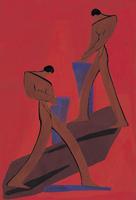
Two Figures
Janos Mattis-Teutsch

Composition with Five Figures
Janos Mattis-Teutsch
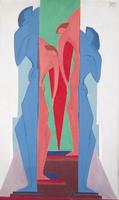
The Manual Workers and the Intellectuals
Janos Mattis-Teutsch

Blue Figure
Janos Mattis-Teutsch

Figure in Landscape
Janos Mattis-Teutsch

Calling
Janos Mattis-Teutsch
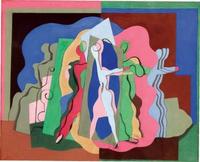
Le bal Musette
Georges Valmier
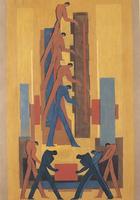
Assembly Line (fresco draft)
Janos Mattis-Teutsch

Composition
Janos Mattis-Teutsch

Nude
Yiannis Moralis
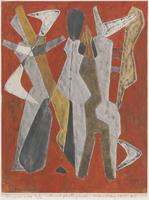
Promenade
Man Ray
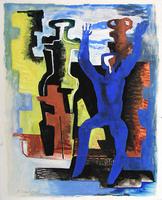
The messengers of the Day
Ossip Zadkine
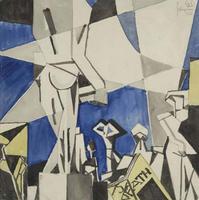
Athens Archaeological Museum
Yiannis Tsaroychis
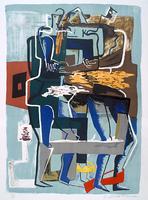
Conversation
Ossip Zadkine
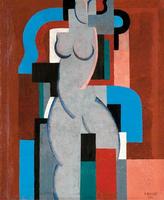
Composition
Gustave Buchet

study #057
Toshihiko Okuya
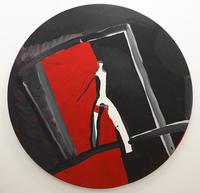
Untitled
Aki Kuroda

Erotic
Yiannis Moralis

Giochi di Donne
Mario Tozzi