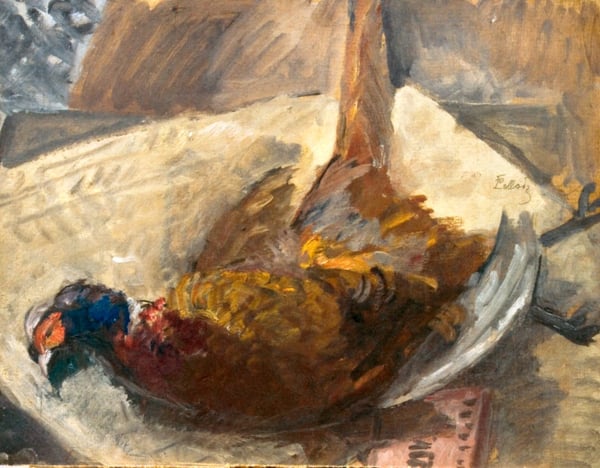
Pheasant
Analisi esperta di Pheasant di Theodor Pallady
Stile: Impressionism · Genere: still life
Expert Analysis: "Pheasant" by Theodor Pallady
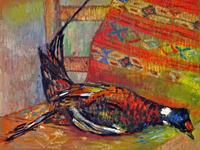
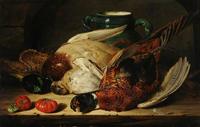
Theodor Pallady’s "Pheasant" stands as a distinguished example of Impressionist still life, demonstrating how the movement’s core concerns—light, atmosphere, and the fleeting moment—can infuse a seemingly static subject with vitality and immediacy. Working within the tradition of nature morte, Pallady transforms the humble pheasant into a study of optical sensation, moving beyond mere representation to capture the bird’s presence as it is perceived under a particular play of light.
Significance within Impressionism:
While still life was a secondary genre for many Impressionists (who favored landscapes and scenes of modern life), artists like Pallady used it to test the movement’s radical techniques. In "Pheasant", the significance lies in:
- Treatment of Light and Atmosphere: The painting likely employs the hallmark Impressionist approach of broken color and visible brushstrokes to render the pheasant’s plumage not as a series of fixed hues but as a shimmering surface that reflects ambient light. The bird’s feathers—iridescent greens, bronzes, and russets—are probably built from dabs of pure pigment, allowing the viewer’s eye to optically blend them, mimicking the way natural light flickers across forms.
- Emphasis on Sensation over Detail: Instead of precise anatomical rendering, Pallady likely prioritizes the overall visual impression—the weight of the game bird, the softness of its breast, the metallic gleam of its neck. This aligns with the Impressionist creed of capturing “the envelope” of air and light surrounding the object.
- Compositional Informality: The still life may be cropped or tilted, borrowing from Japanese prints (a major influence on Impressionism), which lends a sense of spontaneity and immediacy. The pheasant might rest on a simple cloth or tabletop, its diagonal placement avoiding static symmetry and drawing the eye across the canvas.
Contribution to Still Life Genre:
Before Impressionism, still life often carried symbolic or moralizing undertones (vanitas, abundance). Pallady’s "Pheasant" shifts the focus to pure visual enjoyment. The bird is no longer a memento mori but a vehicle for exploring:
- Chromatic Harmonies: Pallady likely plays with complementary colors (the warm ochres and reds of the pheasant against cool grays or blues in the background) to heighten intensity, creating a vibrant, almost decorative surface.
- Texture via Brushwork: The application of paint becomes integral to the subject. Soft, feathery strokes for the plumage contrast with smoother passages for inanimate objects, celebrating the physical act of painting as much as the subject itself.
Within Pallady’s Oeuvre:
As a Romanian artist trained in Paris (where he studied under Gustave Moreau and was exposed to Impressionism), Pallady brought a distinctive sensibility to the style. "Pheasant" likely reflects his lifelong interest in intimate, domestic subjects—a recurring theme in his work that tempers Impressionist spontaneity with a quiet, contemplative order. The painting is significant as a bridge between French Impressionist innovations and Eastern European artistic traditions, proving that the movement’s principles could be adapted to still life without losing their revolutionary energy.
In sum, "Pheasant" is not merely a depiction of game but a vibrant field of optical experience—a testament to Pallady’s mastery of Impressionist color theory and his ability to find profound beauty in the ordinary. It reminds us that for the Impressionists, even the most humble object could be a vehicle for light and life.
Genere
Stile
Visivamente simili
20 opere con composizione e palette affini
Two Hanging Pheasants
Gustave Caillebotte
Hanging Pheasants
Alexander Pope
Pheasant
George Stefanescu
Dead Pheasant in the Snow
Pierre-Auguste Renoir
Pheasant
Viorel Marginean
Dead Pheasant
John Ruskin
Cock and Hen Pheasant at the Edge of a Wood
Archibald Thorburn
A Pair of Pheasants in the Snow
Ohara Koson
Autumn Covert
Archibald Thorburn
Pheasant Display
Charles Tunnicliffe
Old English Pheasant
Archibald Thorburn
Cock and hen pheasant in the undergrowth
Archibald Thorburn
Still life with a hare, a pheasant and a red partridge
Jean-Baptiste Oudry
Ring-neck Pheasants
Charles Tunnicliffe
A Cock Pheasant
Archibald Thorburn
Pheasants
Vanessa Bell
The Chinese Pheasant
Joseph Wolf
Still Life with Pheasant, Partridge and Duck
Edward Ladell
Birds from Nature
Edward Ladell
The pate
Jean-Baptiste Oudry