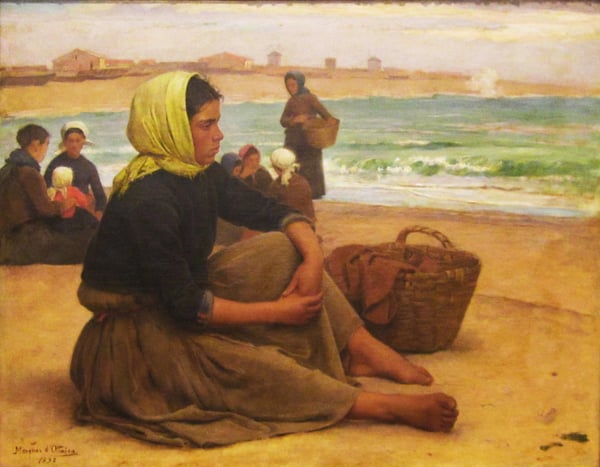
Analisi esperta di A Apanha do sargaço di António de Carvalho da Silva Porto
Stile: Realism · Genere: genre painting
Artwork Analysis: A Apanha do sargaço (The Gathering of Sargassum) by António de Carvalho da Silva Porto
Style & Context
Executed in the Realist tradition, this genre painting captures a humble, labor-intensive task: the collection of sargassum seaweed along the Portuguese coast. Silva Porto, a leading figure of Naturalism in Portugal and deeply influenced by the Barbizon school, brought a plein-air sensibility to his work. He focuses not on heroic or dramatic subjects, but on the quiet dignity of everyday rural life—a core tenet of Realism.
Composition & Technique
The composition likely places the figures in a broad, sunlit beach or rocky shoreline, with the sargassum gathered in piles or being carried. Silva Porto’s brushwork would emphasize the textures of wet seaweed, coarse clothing, and the shifting light of the Atlantic coast. His palette—muted earth tones balanced with the cool blues and grays of sea and sky—reinforces the scene’s authenticity. The figures are not idealized; they are shown in natural postures of work, their faces possibly obscured or turned away, making them representative of a collective rather than individuals.
Significance within Realism
-
Elevation of the Mundane: By choosing a seaweed harvest—a peripheral, unglamorous chore—Silva Porto aligns with Realism’s mission to document the lives of ordinary people. The painting valorizes labor that was essential to coastal communities but rarely depicted in fine art.
-
Portuguese Naturalism: Silva Porto was instrumental in introducing Naturalism (a French-derived branch of Realism) to Portugal. A Apanha do sargaço exemplifies his commitment to painting en plein air and capturing the specific light, atmosphere, and geography of his homeland, distinguishing it from more generic rural scenes.
-
Social Commentary: The work subtly critiques the harshness of subsistence living. Sargassum was used as fertilizer or fuel—a low-status resource. Silva Porto’s objective eye avoids sentimentality, instead offering a factual record of the struggle and resilience of coastal laborers.
Legacy
This painting remains a key example of how Realism adapted to local conditions outside France. It underscores Silva Porto’s role in modernizing Portuguese art, steering it away from academic history painting toward a truthful, empathetic depiction of national life. A Apanha do sargaço stands as both a document of a vanishing tradition and a masterful study of light, texture, and human endurance.
Genere
Stile
Visivamente simili
20 opere con composizione e palette affini
La Merenda
Elin Danielson-Gambogi
Shepherdess of Douarnenez
Jules Breton
A short break
Cristiano Banti
Souvenir de dour Amenez
Jules Breton

Women of Ruokolahti on the Church Hill
Albert Edelfelt
At the Seashore
Anna Bilińska
Peasant woman at rest
Silvestro Lega

Auvers-sur-oise
Charles Sprague Pearce
High Tide, Étretat
Daniel Ridgway Knight
Peines De Coeur
Charles Sprague Pearce
Madeleine in An Wheat Field
Daniel Ridgway Knight
Laundresses on Lake Garda
Ettore Tito
Women on the Beach at Berck
Eugene Boudin

Country idyll
Egisto Ferroni

Returning home
Pasquale Celommi
Break For Refreshment, Harvest Time
John Absolon
The Harvest
Frederick Morgan
A Fisherman's Daughter
Jules Breton
Study for ''The Tea Break'' (August 10, 1885)
Jules Breton
Laundresses on the Banks of the Touques
Eugene Boudin