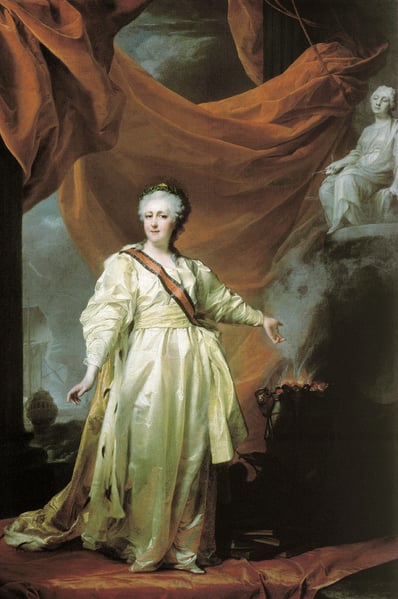
Portrait of Catherine II as Legislator in the Temple of the Goddess of Justice
Dettagli
Analisi esperta di Portrait of Catherine II as Legislator in the Temple of the Goddess of Justice di Dmitry Levitzky
Stile: Neoclassicism · Genere: portrait
Expert Analysis: "Portrait of Catherine II as Legislator in the Temple of the Goddess of Justice"
Dmitry Levitzky’s portrait of Catherine II is a quintessential Neoclassical allegory, designed to elevate the empress beyond mere likeness into an embodiment of enlightened rule. Within the Neoclassical tradition—which prized clarity, order, and moral didacticism—the painting stands out for its fusion of portraiture with political ideology.
The title explicitly anchors the work in a classical temple setting, linking Catherine to the goddess of justice (likely Themis or Justitia). This is not a casual domestic portrait; it is a state-sponsored manifesto. By casting the empress as a legislator, Levitzky reinforces the Enlightenment ideal of the monarch as a rational lawgiver, a concept championed by Catherine herself, who corresponded with Voltaire and authored the Nakaz (Instruction) for a new legal code.
The composition likely employs Neoclassical devices: a solemn, dignified pose; classical architectural elements (columns, temple space); and symbolic attributes—perhaps a scroll or lawbook—to signify wisdom and justice. The drapery and formal restraint reflect the period’s preference for idealized forms over Baroque emotionalism.
Significance within the period:
- Political propaganda: The portrait justifies Catherine’s reign as legitimate and virtuous, casting her as a secular saint of justice. In an era when rulers used art to project authority, Levitzky’s work merges the personal (portrait) with the universal (allegory).
- Neoclassical rigor: It avoids Rococo frivolity; the emphasis is on civic virtue and order, aligning with the style’s revival of Greco-Roman gravitas. The temple setting deliberately echoes ancient Roman state reliefs and public monuments.
- Genre innovation: By hybridizing portraiture with history painting (typically reserved for mythological or biblical subjects), Levitzky elevates a contemporary ruler to heroic status—a hallmark of Neoclassical state portraiture.
In essence, this work is significant as a masterful example of how Neoclassical art functioned as a tool of political theology, using clear, stoic forms to sanctify power and reason. It remains a key artifact of Catherine’s self-fashioned image as the “Minerva of the North.”
Museum / Gallery
Visivamente simili
20 opere con composizione e palette affini
Portrait of Catherine II as Legislator in the Temple of the Goddess of Justice
Dmitry Levitzky
Portrait of Greate russian empress Catherine II
Dmitry Levitzky
Portrait of Empress Elizabeth Petrovna
Charles-Andre van Loo (Carle van Loo)
Portrait of Catherine II of Russia
Dmitry Levitzky
Maria Isabella, Infanta of Spain
Pieter van Hanselaere
Portrait of Ekaterina Petrovna Shuvalova
Vincenzo Camuccini
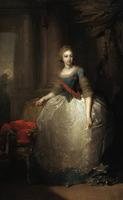
Portrait of Elena Pavlovna
Vladimir Borovikovsky
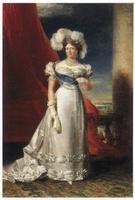
Portrait of Empress Marie Fyodorovna
George Dawe
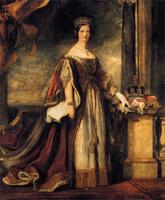
Queen Victoria (detail)
David Wilkie
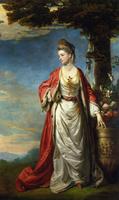
Mrs. Trecothick, Full Length, in Turkish Masquerade Dress, Beside an Urn of Flowers, in a Landscape
Joshua Reynolds
Queen Adelaide
John Simpson
Empress Alexandra Feodorovna at the Coronation of Her Husband
George Dawe
Retrato de D. Carlota Joaquina, Rainha de Portugal
Domingos Sequeira
Portrait of Catherine II
Dmitry Levitzky
Portrait of Victoria of the United Kingdom
Franz Xaver Winterhalter
Johanna Holstein Gottorp
Antoine Pesne

Mrs. Thomas Scott Jackson
George Romney
Retrato de María Teresa I
Martin van Meytens
Lady Ligonier
Thomas Gainsborough

Portrait of Victoria of the United Kingdom
Franz Xaver Winterhalter