
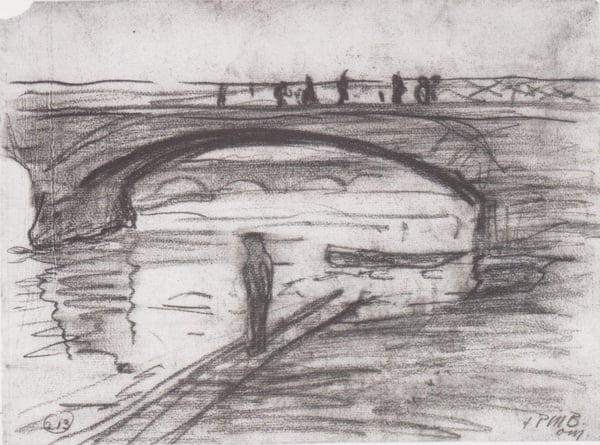
Analisi esperta di Bridges in Paris di Paula Modersohn-Becker
Stile: Expressionism · Genere: cityscape
Artwork Analysis: "Bridges in Paris" by Paula Modersohn-Becker
Style: Expressionism
Genre: Cityscape
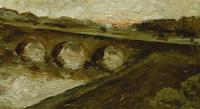
Paula Modersohn-Becker’s Bridges in Paris stands as a pivotal work within early German Expressionism, capturing the artist’s transformative encounter with modern urban life. Painted during her stays in Paris between 1900 and 1906, the work reflects her synthesis of Post-Impressionist color theory—influenced by Cézanne and Gauguin—with a raw, emotive distortion of form that anticipates the Expressionist movement.
Significance in Context
A Bridge Between Movements
Modersohn-Becker was among the first artists to consciously merge the structural clarity of Post-Impressionism with the subjective intensity that would define Expressionism. In Bridges in Paris, the composition is reduced to simplified, almost geometric planes: the arched bridges and riverbanks are rendered in bold, flattened shapes, foreshortened and tilted to evoke a sense of dynamic, lived experience rather than literal topography. This deliberate simplification—eschewing detailed perspective in favor of rhythmic line and blocky color—declares a break from naturalistic representation, prioritizing the artist’s inner response to the city.
A Female Vision of Modernity
At a time when female artists were largely relegated to domestic or floral subjects, Modersohn-Becker claimed the cityscape—a traditionally masculine genre—as her own. Her Parisian bridges are not merely tourist views; they are expressions of a solitary, introspective observer navigating the industrializing metropolis. The muted earth tones juxtaposed with patches of vibrant blue and green suggest both the grit and energy of the Seine’s banks, while the faceless, anonymous figures hint at urban alienation—a theme later fully developed by Expressionist peers like Kirchner.
Proto-Expressionist Color and Line
The painting’s significance also lies in its radical use of color. Modersohn-Becker abandons local color for emotional weight: the sky may shift from ochre to violet, and the water becomes a series of coppery, unblended strokes. This liberation of hue from reality directly influenced the Brücke group in Dresden, who admired her work. The bold, black contour lines that define the bridges and buildings prefigure the graphic, angular style of later Expressionist woodcuts.
Legacy
Bridges in Paris encapsulates Modersohn-Becker’s brief but explosive career—she died at 31—and her role as a forgotten pioneer. Though overshadowed by male Expressionists for decades, her experiments with form and color here mark a critical step toward the emotional directness that came to define early 20th-century German art. The painting is not just a depiction of a place but a testament to how one artist transformed the act of seeing into a personal, almost defiant, visual language.
Visivamente simili
20 opere con composizione e palette affini
The bridge
Pellizza da Volpedo
Bridge Over River
Cornelis Vreedenburgh
Misty Morning on the Seine
Frederick Carl Frieseke
Waterloo Bridge
Claude Monet
Le Pont des Arts
Robert Demachy
Boats on the Seine
Gustave Loiseau
Ponte Santa Trinita
Childe Hassam
Bridge in Saint Cloud
Konstantin Korovin
Rome, the Milvian Bridge
Michele Cammarano
Scheiber Hugó, Szajna Part
Scheiber Hugó
Ponte Sul Ticino
Giuseppe Barberis
Solothurn
Cuno Amiet
Bridge near Giverny
Theodore Robinson
Laundresses on the Banks of the Touques
Eugene Boudin
Cityscape with Bridge
Bela Kadar
Sailboats at Chatou
Maurice de Vlaminck
The Pont Neuf
Albert Marquet
Augustus Bridge - Dresden
Oskar Kokoschka
London Bridge
Andre Derain
Vue De Paris
Henri Matisse