Analisi esperta di Still life with fish bowl di Paula Modersohn-Becker
Stile: Post-Impressionism · Genere: still life
Expert Analysis: "Still Life with Fish Bowl" (ca. 1906–1907) by Paula Modersohn-Becker
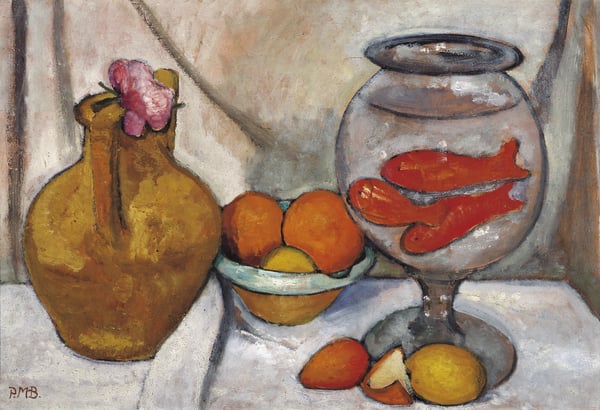
As a pivotal figure in the transition from Post-Impressionism to early Expressionism, Paula Modersohn-Becker’s Still Life with Fish Bowl exemplifies her radical departure from traditional still-life conventions. Executed in the later years of her tragically short career, the work draws on Post-Impressionist principles—particularly the flattened spatial planes and heightened color palette inspired by Cézanne and Gauguin—yet pushes toward a more personal, emotionally charged realism.
Significance within Post-Impressionism and Genre:
-
Subversive Subject Choice: Unlike the opulent, decorative still lifes of the 19th century, Modersohn-Becker selects a humbly domestic motif—a simple fish bowl—and imbues it with a taut, almost monumental stillness. The bowl, often portrayed as a transparent enclosure for living creatures, becomes a microcosm of life and containment, reflecting her interest in the quiet dignity of everyday objects.
-
Bold, Simplified Forms: The composition reduces the fish bowl and its surrounding elements (likely a tabletop, perhaps fruit or a cloth) to essential, almost geometric volumes. This simplification, characteristic of Post-Impressionism’s move away from naturalistic illusion, anticipates the expressive distortions of later Expressionism. Her handling of the glaze or glass surface is not about transparency but about solid, rhythmic contour—an audacious choice that emphasizes the object’s physical presence over literal depiction.
-
Color as Emotion: Modersohn-Becker uses a limited but intense palette. The fish bowl likely contains warm ochres, deep greens, and cool blues—colors that pulse with inner life rather than merely describing the scene. This use of color to convey psychological mood rather than optical truth is a hallmark of her mature style and connects her to the Post-Impressionist desire to express “the essential” beyond surface appearance.
-
Interaction of Stillness and Vitality: The fish, if depicted, become living dots of movement within an otherwise frozen arrangement. This tension—between the static, almost sculptural bowl and the dynamic life inside—creates a contemplative resonance. Modersohn-Becker’s still lifes often capture that pause between breaths, making the viewer conscious of time and mortality—a theme that gains poignance given her own early death in 1907.
Art-Historical Impact:
Still Life with Fish Bowl is significant because it demonstrates how a woman artist working outside the Parisian mainstream (she trained in Paris but lived in the rural Worpswede colony) could absorb Post-Impressionist lessons and forge a deeply personal, modern voice. Her still lifes are not mere exercises in form or decoration but intimate meditations, bridging the objectivity of Cézanne with the subjectivity of Expressionism. This work, like much of her oeuvre, helped redefine the still-life genre as a vehicle for existential inquiry—a legacy that would influence German Expressionist painters such as Karl Schmidt-Rottluff and Ernst Ludwig Kirchner.
Museum / Gallery
Visivamente simili
20 opere con composizione e palette affini
Goldfish Bowl
Henri Matisse
Kala-asetelma
Elga Sesemann
The Aquarium
Georges Braque
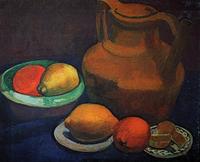
Still life with jug
Paula Modersohn-Becker
Still Life
Fernando García Ponce
Fruit and Jug on a Table
Paul Cezanne
Still Life with Lemons
Adalbert Erdeli
Goldfish and Palette
Henri Matisse
Dishes and Fruit on a Red and Black Carpet
Henri Matisse
Blaue Vase mit Orangen
Alexej von Jawlensky
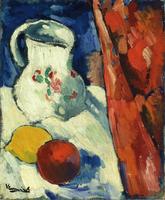
Still Life with Pitcher and Fruit
Maurice de Vlaminck
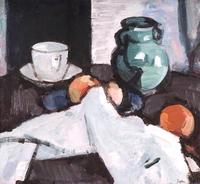
Still Life with Bowl of Fruit, Jug, Cup and Saucer
Samuel Peploe
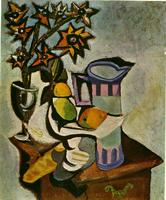
Untitled
Pablo Picasso
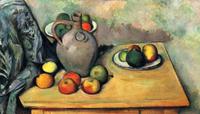
Still life, jug and fruit on a table
Paul Cezanne
Untitled
Bahman Mohasses
Still life with fruits
Paul Cezanne
Two mullets
Georges Braque
Lemons and Bottle of Dutch Gin
Henri Matisse
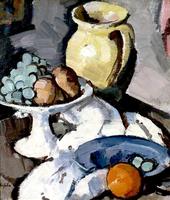
The Yellow Jug
Samuel Peploe
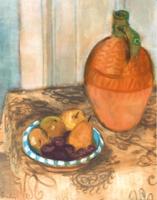
Berény Róbert, Műtermi Csendélet
Berény Róbert