
Expertenanalyse zu Yaacov Agams Hidden Rainbow x9
Stil: Concretism · Genre: abstract
Expert Analysis of "Hidden Rainbow x9" by Yaacov Agam
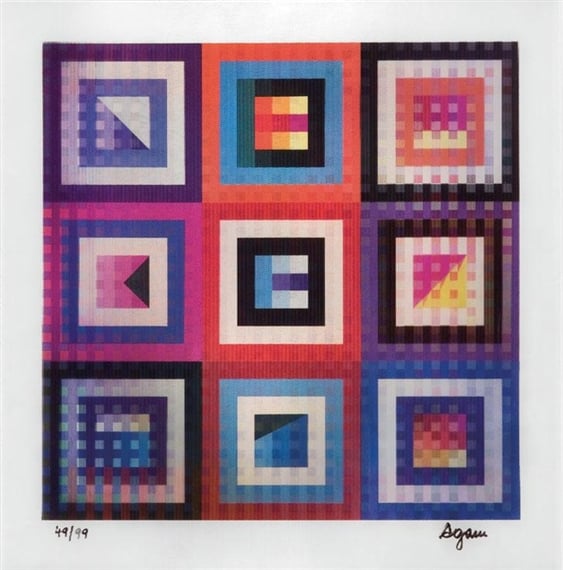
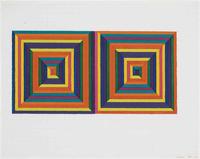
Yaacov Agam’s Hidden Rainbow x9 (ca. 1970s–1980s) stands as a quintessential example of Concretism inflected with kinetic and optical play. While Concretism traditionally emphasizes geometric abstraction, mathematical order, and the rejection of illusionistic depth, Agam radically expands its vocabulary by introducing temporal and participatory dimensions—hallmarks of his signature Agamograph technique.
Structural and Formal Significance
The work’s title, “Hidden Rainbow,” directly signals its core mechanism: color is not fixed but revealed through viewer movement. Using a lenticular or prismatic surface (often ribbed or layered), Agam interlaces vertical strips of contrasting hues. From a single vantage point, the composition appears as a subdued or fragmented arrangement of geometric forms. However, as the spectator shifts position, a full spectrum of saturated color—from red to violet—appears and disappears, creating a dynamic, ever-changing visual field. The “x9” likely denotes a nine-panel or nine-stage sequence, reinforcing the systematic, modular logic prized by Concretism.
Reinterpretation of Concretist Ideals
Agam aligns with Concretism’s insistence on autonomy of form and rejection of representational content. The work is entirely non-objective—its subject is pure color, light, and motion. Yet Agam challenges the movement’s traditional static, frontal viewing by making the artwork dependent on the observer’s active engagement. Here, the concrete object is not a fixed entity but a set of possibilities realized only through time and bodily movement. This aligns with Agam’s broader philosophy of tactic art, where the viewer completes the piece.
Technological and Perceptual Innovation
What makes Hidden Rainbow x9 significant is its fusion of rigorous geometric abstraction with perceptual science. The work exploits the persistence of vision and chromatic afterimages, forcing the eye to synthesize fragments into coherent shape. This places Agam in dialogue with Op Art and kinetic art movements of the 1960s–70s, yet he remains firmly rooted in Concretist discipline: the rainbow effect is not arbitrary but precisely calibrated through mathematical spacing and color intervals.
Conclusion
Hidden Rainbow x9 is a breakthrough that expands Concretism’s boundaries without abandoning its core principles. It demonstrates that pure abstraction can be dynamic, interactive, and temporally unfolding, offering a model of art that is both rigorously constructed and endlessly variable—a precursor to contemporary immersive and participatory works. Agam thereby secures the work’s significance as a bridge between the geometric rigor of Concrete art and the perceptual experiments of the late-modernist avant-garde.
Visuell ähnlich
20 Werke mit ähnlicher Komposition und Farbpalette
Education
Johannes Itten
OND-DVA
Victor Vasarely
Happy Island
Johannes Itten
Geometric Composition
Ivan Serpa
Neun systematische Farbreihen mit horizontaler und vertikaler Verdichtung
Richard Paul Lohse
Cross
Edna Andrade
Sem Título
Manuel Cargaleiro
Grand Treasure
Richard Anuszkiewicz
Untitled
Rubem Ludolf
DVA-DVA
Victor Vasarely
Collage
Julio Le Parc
Orion-K
Victor Vasarely
Untitled
Guido Molinari
Konstruktion um das thema 3-4-5
Max Bill
Infinite Reach
Yaacov Agam
The Fourth 'Book of Schemes'. Album #2, the First Folder
Valerii Lamakh
Espaço Ilusório
Eduardo Nery
Progression
Richard Paul Lohse
Sararas XX
Omar Rayo
Fortín de las Flores
Frank Stella