Collage
Expert analysis of Julio Le Parc’s Collage
Style: Op Art · Genre: abstract
Expert Analysis of Julio Le Parc’s Collage (Op Art, Abstract)
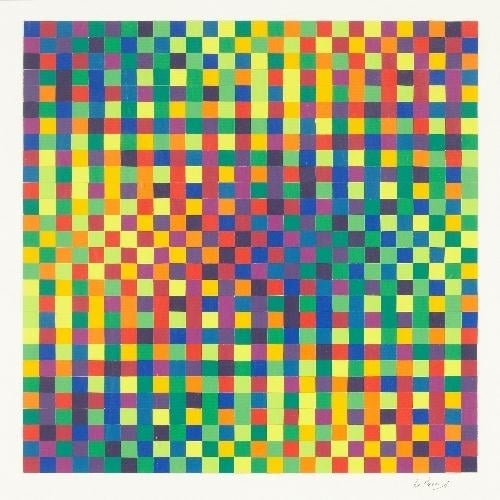
Julio Le Parc’s Collage stands as a pivotal example of how Op Art transcends mere optical illusion to become a rigorous investigation of perception itself. As a founding member of the Groupe de Recherche d’Art Visuel (GRAV), Le Parc championed art that was systematic, participatory, and anti-hierarchical. This abstract collage embodies those principles.
What Makes It Significant
-
Systematic Disorder – Le Parc often employed predetermined systems (e.g., permutations of lines, colors, or shapes) to generate kaleidoscopic patterns. In Collage, the juxtaposition of carefully cut geometric fragments—likely contrasting black, white, and spectral hues—creates a vibrant, unstable surface. The composition oscillates between flatness and depth, inviting the eye to flicker and search for order in apparent chaos.
-
Kinetic Without Motion – Unlike many Op artists who relied on painted moiré effects, Le Parc’s Collage uses physical cut paper to produce a virtual vibration. The tangibility of the medium (collage as assembled fragments) reinforces the tension between static material and dynamic perception. Viewers experience the work as if it were in constant flux—a hallmark of Le Parc’s goal to “destabilize the retinal experience.”
-
Democratic Viewer Engagement – Le Parc rejected the idea of the artist as solitary genius. His collages often function as test sites for perceptual phenomena, where the viewer’s movement—of head, eyes, or body—activates the piece. Collage rewards prolonged looking, revealing shifting afterimages and rhythmic structures that never settle into a single reading. This participatory element aligns with GRAV’s manifesto: art as “a means of action on the spectator.”
-
Legacy in Op and Kinetic Art – While Le Parc is celebrated for mobiles and light installations, Collage demonstrates his mastery of two-dimensional space as a field of sensory interrogation. It bridges the hard-edge geometric abstraction of the 1960s with the immersive, spectator-driven experiences later explored by artists like Carlos Cruz-Diez and Bridget Riley.
In sum, Julio Le Parc’s Collage is not an aesthetic decoration but a perceptual puzzle. Its significance lies in how it renders the act of seeing itself as the artwork’s subject—a core innovation of Op Art that continues to influence contemporary experiential and digital art.
Visually similar
20 works with related composition and palette
Happy Island
Johannes Itten
Geometric Composition
Ivan Serpa
Cor-Luz
Eduardo Nery
Echiquier
Aurelie Nemours
Serie 26D, No. 1-3 3-1, 3-1 1-3
Julio Le Parc
Eight Colour Groups
Max Bill
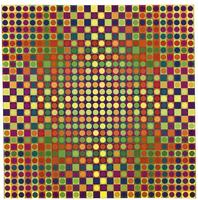
Serie 29D No. 1-1 8-8 1-1 8-8
Julio Le Parc
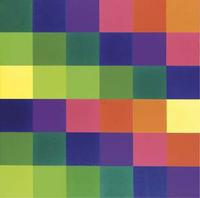
Six systematical colour rows from bright to bright
Richard Paul Lohse
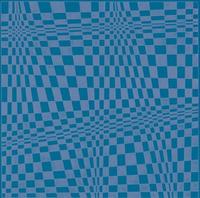
Disegno ottico dinamico
Dadamaino
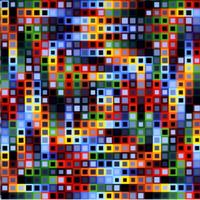
Orion-K
Victor Vasarely
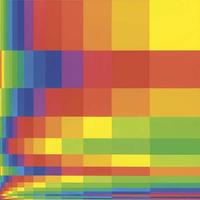
Progression
Richard Paul Lohse
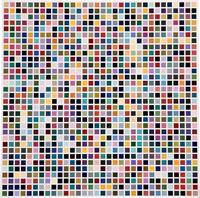
1024 Colours
Gerhard Richter
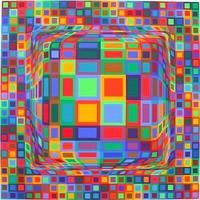
OND-DVA
Victor Vasarely
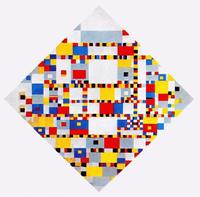
Victory Boogie Woogie
Piet Mondrian
Untitled
Yaacov Agam
Contrastes chromatiques
Gregorio Vardanega
Broadway Boogie Woogie
Piet Mondrian
Johnson and Johnson Model
Robert Swain
Hidden Rainbow x9
Yaacov Agam
Sechs systematische Farbreihen mit blaugrünen und violetten Akzenten
Richard Paul Lohse