Analisi esperta di The Cardplayer di Louis Marcoussis
Stile: Cubism · Genere: portrait
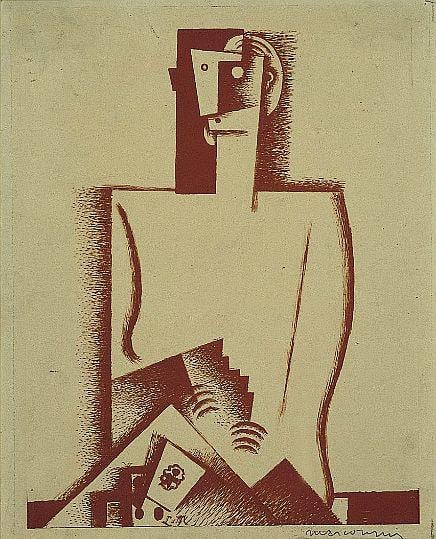
Louis Marcoussis’s The Cardplayer exemplifies a key moment in the development of Cubist portraiture, where the traditional depiction of a sitter is subsumed into the fractured, multi-perspective language of the movement. As a work by a Polish-French painter closely linked to the School of Paris, it demonstrates how Cubism could be applied not only to still lifes and abstracted heads but also to narrative scenes—here, the everyday act of playing cards.
Significance within Cubism:
-
Integration of Figure and Environment: Unlike earlier Cubist portraits that often isolate the sitter against a neutral ground, Marcoussis merges the cardplayer’s body with the table, cards, and surrounding space. The figure’s profile and torso are broken into geometric facets that echo the angularity of the tabletop and the scattered playing cards. This dissolution of distinct objects into a unified, planar grid is a hallmark of Synthetic Cubism.
-
Lyrical and Decorative Approach: Marcoussis belongs to a generation of Cubists who softened the austerity of Picasso and Braque’s analytical phase. In The Cardplayer, the palette is more varied and warmer—ochres, muted greens, and blues—while the patterning of lines and segmented planes creates a rhythmic, almost musical effect. This decorative yet structured quality sets the work apart from the more monochromatic, deconstructive experiments of earlier Cubism.
-
Genre Innovation: While Cubism is often associated with still life and the fractured portrait, Marcoussis introduces a narrative element: the cardplayer caught mid-game. This adds a temporal dimension—the suggestion of movement, choice, and chance—within a style that typically freezes its subjects in a timeless, simultaneous view. The segmentation of the figure’s hands and face reflects the multiple moments of a gesture (shuffling or holding cards) rendered as a single, composite image.
Significance as a Cubist Portrait:
-
The genre of portraiture in Cubism traditionally challenged the idea of a fixed, singular likeness. Marcoussis’s cardplayer is not a specific individual but a typology—a “cardplayer” as a universal figure. This aligns with Cubism’s interest in essences over surfaces. The sitter’s facial features (an eye seen from the front, a nose in profile) are scattered and reassembled, forcing the viewer to synthesize the image actively, much as one would read a card hand.
-
The inclusion of depicted text or number-like shapes (common in Cubist works, often resembling card suits or score marks) anchors the portrait in a specific cultural activity. This interplay between abstraction and legibility—recognizing a person at cards while seeing a composition of shifting planes—highlights Cubism’s central tension: representing the world through a new visual logic.
In summary, The Cardplayer is significant for its successful blend of Cubist formal principles—fragmentation, multiple viewpoints, and integration of subject and space—with a distinctively lyrical and accessible sensibility. It demonstrates how Cubism could adapt to narrative portraiture, expanding the movement’s reach beyond the atelier into the realm of daily life, while maintaining intellectual rigor and visual complexity.
Visivamente simili
20 opere con composizione e palette affini
Still life with Compote
Lyubov Popova
Glass, bottle, packet of tobacco
Pablo Picasso
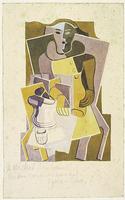
Harlequin
Juan Gris
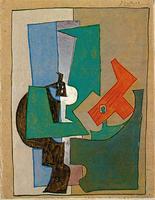
Pedestal
Pablo Picasso
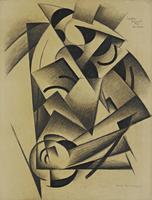
Looping
Félix Del Marle
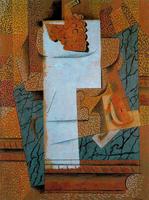
Fruit vase and bunch of grapes
Pablo Picasso
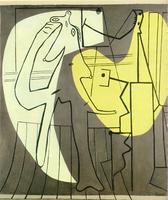
Painter and his model
Pablo Picasso
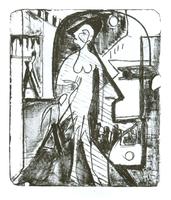
Encounter
Ernst Ludwig Kirchner
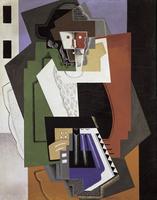
The Accordion Player
Gino Severini
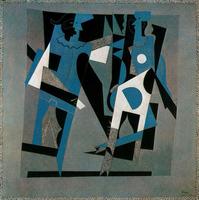
Harlequin and woman with necklace
Pablo Picasso
The table
Pablo Picasso
Composition
Henri Laurens
The Piano Lesson
Georges Valmier
Femme au Fauteuil
Albert Gleizes
Woman with guitar
Pablo Picasso
The Musician
Georges Braque
Couple
Louis Marcoussis
Framför toalettspegeln
Otto Gustav Carlsund
Figura
Mario Tozzi
La bouteille
Henri Laurens