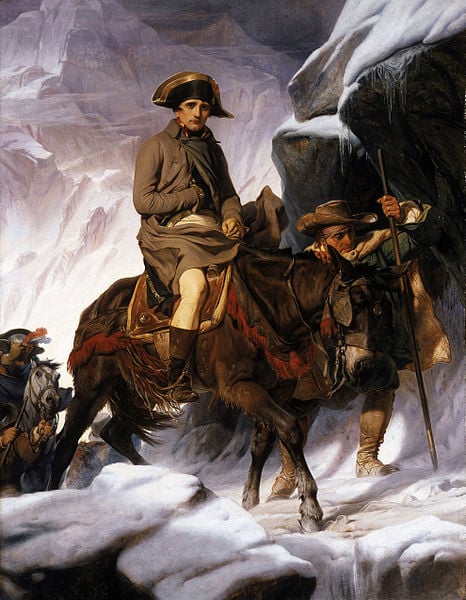
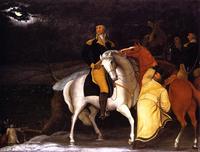
Based solely on the structured facts provided—style (Academicism, Romanticism) and genre (history painting)—the significance of Paul Delaroche’s “Napoleon crossing the Alps” lies in its strategic fusion of two seemingly opposing artistic currents. As a history painting, it engages with a grand, pivotal moment, but its stylistic identity bridges the formal discipline of Academicism (precision, clear composition, idealized forms) with the emotional intensity and individual heroism central to Romanticism. This synthesis marks the work as a key example of how Academic painters of the 19th century incorporated Romantic themes without abandoning classical rigor, making the painting significant for demonstrating that history painting could serve both as a chronicle of fact and a vehicle for subjective drama. The specific choice of Napoleon as subject further underscores this blend: the emperor embodies the Romantic cult of the great individual, while the academic treatment confers timeless, monumental dignity on the scene.