Albert Joseph Moore の Hairpins の専門的な分析
スタイル:Academicism · ジャンル:portrait
Expert Analysis of "Hairpins" by Albert Joseph Moore
Style: Academicism | Genre: Portrait
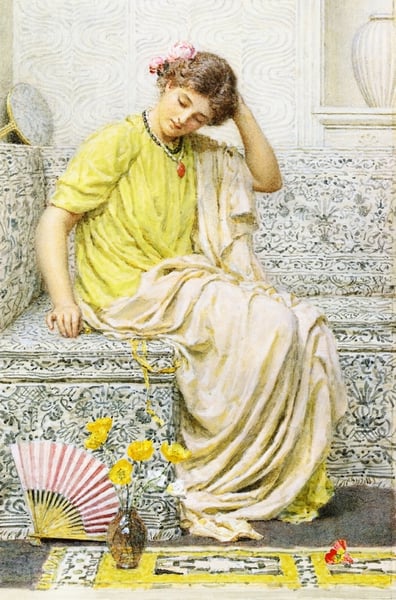
Albert Joseph Moore’s "Hairpins" is a masterful distillation of the Aesthetic Movement’s core tenets, executed within the disciplined framework of Academicism. At first glance, the work appears to be a straightforward portrait of a young woman adjusting her hairpins, but its true significance lies in its deliberate subordination of narrative and psychology to pure visual harmony.
Significance Within Academicism and the Aesthetic Movement
Moore was a pivotal figure in the late-19th-century British Aesthetic Movement, which championed “art for art’s sake.” "Hairpins" exemplifies this philosophy: the subject’s identity, emotional state, or story is irrelevant. Instead, Moore focuses on the interplay of line, color, and form. The composition is an exercise in classical balance—the woman’s tilted head, the graceful arc of her arms, and the vertical accents of the hairpins create a rhythmic, almost musical arrangement. This reflects Moore’s deep study of Greek sculpture and Renaissance frescoes, whose idealized figures he translated into a modern, decorative idiom.
Decorative Beauty and Technical Precision
Moore’s Academic training is evident in his flawless draughtsmanship and handling of flesh tones. The skin is rendered with a cool, porcelain luminosity, while the drapery—likely a loosely wrapped chiton—flows in sinuous, weightless folds. The title "Hairpins" draws attention to a mundane ritual, but Moore elevates it to a study in tactile geometry: the metallic glint of the pins contrasts with soft hair and fabric, anchoring the viewer’s eye. The palette is restrained—soft creams, muted terracottas, and pale blues—demonstrating Moore’s belief that color should be harmonious rather than dramatic.
Contribution to the Portrait Genre
While nominally a portrait, "Hairpins" is more a genre scene stripped of anecdote. Moore’s figures are never individualized; they are types—eternal, serene, and removed from time. This approach was radical for its era, rejecting Victorian moralizing in favor of pure aesthetic pleasure. The painting’s significance lies in its influence on later decorative painters and designers, particularly in its integration of fine art with interior design (Moore often designed the frames for his works, treating the entire object as a cohesive ornament).
Conclusion
"Hairpins" is significant as a quintessential example of Aesthetic Academicism—a work where technical rigor serves not storytelling but an almost abstract celebration of beauty. Through its serene composition, refined palette, and focus on a simple, intimate gesture, Albert Joseph Moore demonstrates that the highest purpose of art can be the creation of enduring visual delight.
Museum / Gallery
ジャンル
スタイル
視覚的に類似
構図やパレットが近い作品 20 件
An Open Book
Albert Joseph Moore
Jasmine
Albert Joseph Moore
A Reverie
Albert Joseph Moore
A Workbasket
Albert Joseph Moore
A Sleeping Girl
Albert Joseph Moore
Tranquillity
John William Godward
Leisure Hours
John William Godward
Sweet Dreams
John William Godward
Vanity
Henry Ryland
Silver
Albert Joseph Moore
Apples
Albert Joseph Moore
After the Festival
Francis Davis Millet
Confidences
Sir Lawrence Alma-Tadema
Mischief
John William Godward
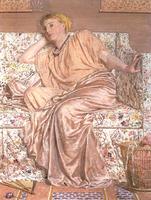
Pansies
Albert Joseph Moore
A Tryst
John William Godward
With Violets Wreathed and Robe of Saffron Hue
John William Godward
Flora
John William Waterhouse
Reading the Story of Oenone
Francis Davis Millet
Flabellifera
John William Godward