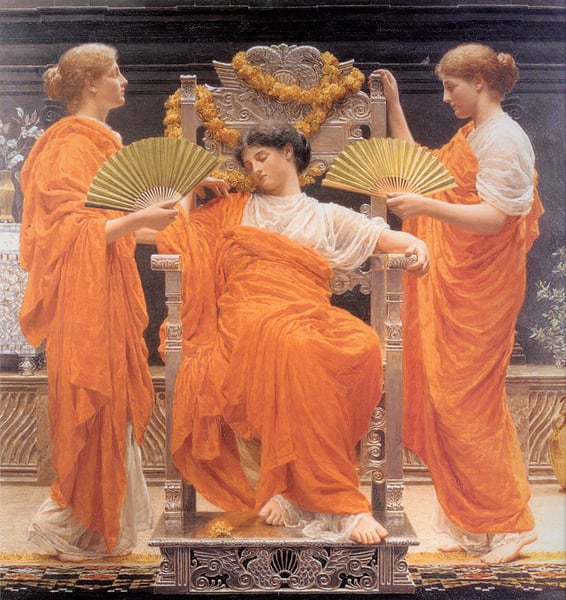
Midsummer
Dettagli
Analisi esperta di Midsummer di Albert Joseph Moore
Stile: Academicism · Genere: genre painting
"Midsummer" by Albert Joseph Moore stands as a quintessential example of late Victorian Academicism that subtly pivots toward the principles of the Aesthetic Movement. Executed with Moore's signature refinement, the painting depicts a group of draped female figures in a sun-drenched, classical setting—a serene, timeless tableau that prioritizes beauty, harmony, and decorative elegance over narrative or moralizing content.
Significance within Academicism and its evolution:
Moore was a master of academic technique—flawless draughtsmanship, balanced composition, and luminous handling of color—yet he pushed beyond the conventional academic emphasis on historical or literary subjects. In Midsummer, the genre scene becomes a vehicle for pure aesthetic experience. The figures are not engaged in a story; they exist in a rhythmic, almost musical arrangement, their poses and flowing drapery echoing the gentle, languorous mood of the season. This approach aligns Moore with the "art for art's sake" philosophy, placing him alongside contemporaries like James McNeill Whistler and Frederic Leighton.
Key features that define the work's importance:
- Color and light as subject: Moore's palette—soft whites, muted golds, pale blues, and delicate flesh tones—creates a unified, atmospheric harmony. The light is diffused and atmospheric, dissolving sharp outlines and emphasizing surface pattern, a technique that anticipates Symbolist and Art Nouveau sensibilities.
- Decorative abstraction: The repetition of vertical folds, the fall of drapery, and the rhythmic grouping of forms transform the human figure into an ornamental motif. This decorative impulse, rooted in classical and Renaissance sources, was Moore's means of elevating genre painting into a meditation on line, color, and balance.
- Influence on later movements: Midsummer exemplifies the shift from High Victorian narrative painting toward an art of pure visual pleasure. Its focus on flat, patterned surfaces and lyrical composition would resonate with the Pre-Raphaelites (particularly Burne-Jones) and later with the decorative ideals of the early 20th century.
In sum, Moore's Midsummer is significant because it demonstrates how Academicism could transcend its own conventions, embracing a proto-modernist emphasis on form and sensation. It is a masterwork of late-19th-century classicism that helped redefine genre painting as a vehicle for aesthetic contemplation.
Genere
Stile
Visivamente simili
20 opere con composizione e palette affini
A Reverie
Albert Joseph Moore
The Honeymoon
Sir Lawrence Alma-Tadema
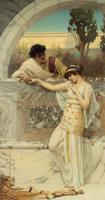
Yes or No
John William Godward
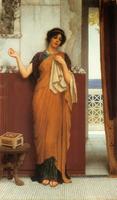
A Stitch in Time (Idle Thoughts)
John William Godward
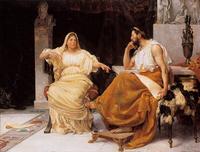
El Pedagogo (Aspasia y Pericles)
José Garnelo
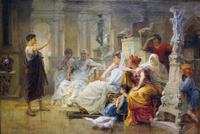
The young Christian neophyte
Diogène Maillart
Vespasian Hearing from One of His Generals of the Taking of Jerusalem by Titus (The Dispatch)
Sir Lawrence Alma-Tadema
Circe Offering the Cup to Ulysses
John William Waterhouse
A Musician
Albert Joseph Moore
Hairpins
Albert Joseph Moore
Azaleas
Albert Joseph Moore
Lesbia Weeping over a Sparrow
Sir Lawrence Alma-Tadema
Topaz
Albert Joseph Moore
Helena and Hermia
Edward Poynter
Preparations for the Festivities
Sir Lawrence Alma-Tadema
Sappho
John William Godward
Apricots
Albert Joseph Moore
Vanity
Henry Ryland

Battledore
Albert Joseph Moore
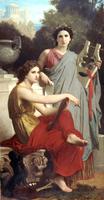
Art and Literature
William-Adolphe Bouguereau