Analisi esperta di He Loves Me, He Loves Me Not di John William Godward
Stile: Neoclassicism · Genere: genre painting
Expert Analysis: "He Loves Me, He Loves Me Not" by John William Godward
This genre painting, executed in the Neoclassical style, epitomizes John William Godward’s late-Victorian fascination with an idealized, sun-drenched antiquity. The work’s significance lies in its meticulous revival of classical motifs and its poignant tension between serene surface beauty and a subtly melancholic narrative.
Context & Style
Godward was among the last generation of British Neoclassical painters, a circle that included Lawrence Alma-Tadema and Frederic Leighton. Unlike the heroic or mythic subjects of earlier Neoclassicism, Godward focused on intimate, decorative scenes of women in classical dress, often engaged in contemplative leisure. "He Loves Me, He Loves Me Not" belongs to this tradition, using the genre painting format—everyday life vignettes—to explore timeless emotional states through a classical lens.
Composition & Technique
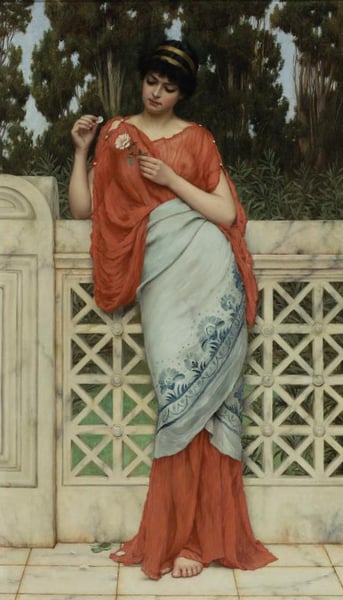
The painting depicts a solitary young woman in a peplos-like gown, seated on a marble parapet against a luminous Mediterranean backdrop. She plucks petals from a daisy, performing the folkloric divination that gives the piece its title. Godward’s technical precision is paramount: the cold, polished gleam of the marble, the diaphanous folds of fabric, the soft rendering of skin and hair all demonstrate his mastery of illusionistic detail. The almost photographic realism is deliberate—it roots the scene in a tangible, sensory world, heightening the universal accessibility of the moment.
Significance within Neoclassicism & Godward’s Career
What makes this work significant is how it embodies the paradox of late Neoclassicism: a style that sought to revive the classical past but did so in a self-consciously modern age. Godward rejected the rising currents of Impressionism, Symbolism, and avant-garde experimentation. Instead, he clung to an aesthetic of serene perfection, of clear forms and quiet harmony. "He Loves Me, He Loves Me Not" is a perfect specimen of this commitment—no grand myth, no dramatic action, only a single woman absorbed in a private ritual of hope and uncertainty.
The title itself introduces a subtle narrative ambiguity that elevates the work beyond mere decorative prettiness. The girl’s pensive expression—neither fully joyful nor sorrowful—invites viewers to project their own emotions onto her. This psychological nuance, rendered through the delicate language of Neoclassical calm, is Godward’s distinctive contribution. The painting thus functions as a bridge between the idealized, impersonal classicism of the early 19th century and the more introspective, mood-driven art that would soon follow.
Furthermore, Godward’s obsessive focus on marble textures and sunlit flesh—so characteristic of his oeuvre—serves as a final, brilliant flare of the academic tradition before Modernism’s upheaval. In this context, "He Loves Me, He Loves Me Not" stands as a poignant testament to a style that, at the very moment of its creation, was already a nostalgic dream. It is both a masterful genre scene and a quiet elegy for an artistic world that was vanishing.
Museum / Gallery
Visivamente simili
20 opere con composizione e palette affini
A Stitch in Time (Idle Thoughts)
John William Godward
Leisure Hours
John William Godward
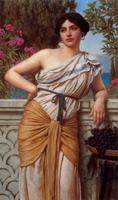
Reverie
John William Godward
The Rendezvous
John William Godward

The Peacock Fan
John William Godward
Sappho
John William Godward
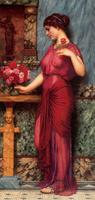
An Offering to Venus
John William Godward
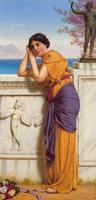
Rich Gifts Wax Poor When Lovers Prove Unkind
John William Godward
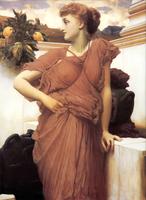
At the Fountain
Frederic Leighton
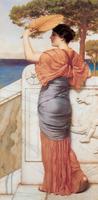
On the Balcony
John William Godward
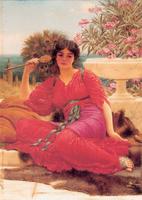
Flabellifera
John William Godward

The Thoughtful One
John William Godward
Yes or No
John William Godward
The Love Letter
John William Godward

A Classical Lady
John William Godward

With Violets Wreathed and Robe of Saffron Hue
John William Godward
Azaleas
Albert Joseph Moore
After the Festival
Francis Davis Millet
The Belvedere
John William Godward
At the Garden Door
John William Godward