Expert analysis of John William Godward’s Reverie
Style: Neoclassicism · Genre: portrait
Expert Analysis: Reverie by John William Godward (c. 1912)
Style & Period Context
John William Godward stands as one of the last dedicated practitioners of Neoclassicism in the late Victorian and Edwardian eras. His work Reverie exemplifies the movement’s core virtues: controlled composition, idealized beauty, and a deep reverence for the art and architecture of ancient Greece and Rome. Yet Godward’s significance lies in how he pushed these classical ideals into a highly personal, almost obsessive realm of technical precision and atmospheric stillness.
Formal & Technical Mastery
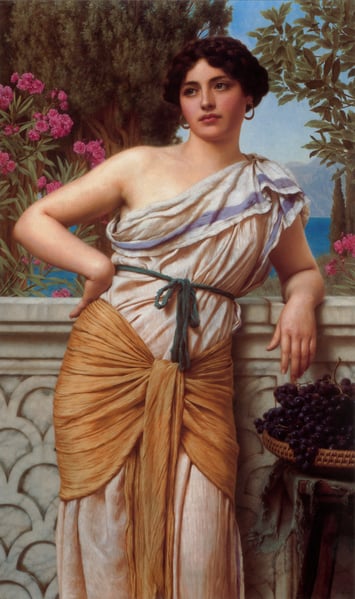
In Reverie, Godward displays his signature command of Marble, saturated color, and tactile fabric. The figure—a young woman in classical drapery—is set against a sunlit parapet and a serene Mediterranean backdrop. Every surface is rendered with photographic clarity: the cool translucency of stone, the soft folds of her peplos, and the warm glow of her skin. This hyper-realistic treatment of materials was Godward’s hallmark, elevating the genre of the classical portrait into a celebration of texture and light.
Iconography & Mood
The title “Reverie” immediately signals the work’s emotional core: solitary contemplation. The woman’s downward gaze and relaxed posture suggest an inner world of thought or memory, a theme Godward revisited throughout his career. Unlike earlier Neoclassical painters who often dramatized mythological narratives, Godward specialized in quiet, timeless moments. This focus on private emotion within a classical framework made his work a bridge between academic idealism and the emerging symbolism of the fin de siècle.
Significance within Neoclassicism
-
Defiance of Modernism: At a time when Impressionism, Post-Impressionism, and avant-garde movements were dominating European art, Godward stubbornly adhered to academic Neoclassicism. Reverie is thus a late, masterful statement of a dying tradition—a deliberate retreat into an imagined, perfect antiquity.
-
Technical Benchmark: Godward’s ability to render marble and flesh with near-photographic realism set a standard for classical-revival painting. Reverie showcases this skill at its peak, demonstrating why he was admired by patrons who valued meticulous craftsmanship over expressive brushwork.
-
Legacy and Tragedy: Godward’s work fell into obscurity after his death (by his own hand in 1922, partially due to the rejection of his style). His revival in recent decades—as a “stubborn classicist” who refused to compromise—makes Reverie a poignant emblem of artistic conviction and the fragility of artistic reputation. It now stands as a key example of late Neoclassicism’s final, exquisite bloom.
Museum / Gallery
Visually similar
20 works with related composition and palette
At the Fountain
Frederic Leighton
A Classical Lady
John William Godward
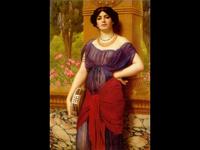
The Tambourine Player
John William Godward
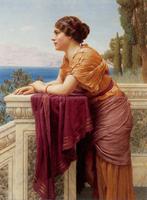
The Belvedere
John William Godward

A Tryst
John William Godward

Contemplation
John William Godward
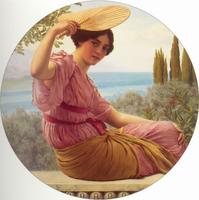
Golden Hours
John William Godward
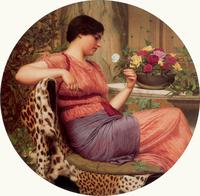
The Time of Roses
John William Godward
Admiring Beauty
Guillaume Seignac
Sappho
John William Godward

With Violets Wreathed and Robe of Saffron Hue
John William Godward
The Ring
John William Godward
Une Beauté À La Source
Guillaume Seignac

Drusilla
John William Godward
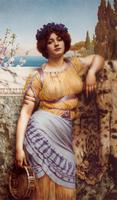
Ionian Dancing Girl
John William Godward
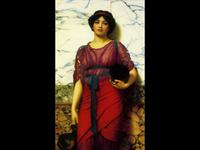
Grecian Idyll
John William Godward

The Love Letter
John William Godward

A Quiet Pet
John William Godward

Rich Gifts Wax Poor When Lovers Prove Unkind
John William Godward

By the Wayside
John William Godward