Analisi esperta di The Jewels Of The Earth di Wojciech Siudmak
Stile: Fantastic Realism · Genere: symbolic painting
Expert Analysis of "The Jewels Of The Earth" by Wojciech Siudmak
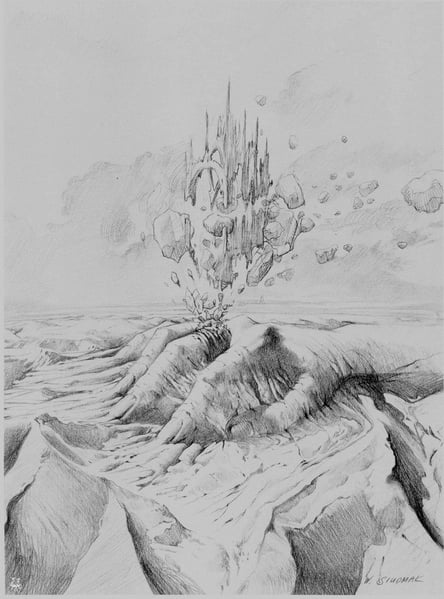
Wojciech Siudmak’s “The Jewels Of The Earth” stands as a compelling example of Fantastic Realism, a movement that marries meticulous, Old Master–style draftsmanship with dreamlike, otherworldly subject matter. Within this style, Siudmak distinguishes himself by fusing hyper-realistic precision with a distinctly cosmic and metaphysical sensibility—often evoking infinite space, crystalline structures, and the tension between the organic and the mechanical.
Significance within Fantastic Realism
- Mastery of Trompe-l’œil and Detail: Siudmak’s technique recalls the Flemish Primitives and the Surrealists, but his focus shifts from psychological dislocation to a kind of poetic naturalism of the impossible. In “The Jewels Of The Earth,” this manifests in surfaces that seem tangible—polished gemstones, geological textures, reflective water—all rendered with a clarity that defies their fantastical arrangement. This hyperreality anchors the viewer in a world that feels plausible despite its impossibility.
- Cosmic Scale and Intimacy: Unlike many Fantastic Realists who dwell on the grotesque or the uncanny (e.g., Ernst Fuchs or H.R. Giger), Siudmak often creates a sense of awe without horror. The “jewels” here are not merely decorative; they appear as vast, floating geode-like forms that dwarf human scale, suggesting that the Earth’s hidden treasures—both literal gems and deeper eruptions of primordial energy—are integrated into a sublime, otherworldly landscape.
- Symbolic Vocabulary: The title itself is a layered symbol. “Jewels” evoke luxury, rarity, and value, but also custodianship and vulnerability. Siudmak presents them not as objects to be mined, but as living, glowing entities embedded in an almost amniotic environment—perhaps a comment on the preciousness of natural resources or the spiritual radiance hidden beneath the planet’s crust.
Genre: Symbolic Painting
As a symbolic painting, the work operates on multiple interpretative levels:
- Alchemical and Geological Allegory: The jewels can be read as lapis philosophorum—the philosopher’s stone—or as archetypes of hidden knowledge. Their polished, crystalline forms evoke both scientific wonder (gemology, geology) and esoteric tradition (the transformative power of the Earth).
- Humanity’s Place in Nature: The absence of human figures is telling. The landscape becomes the protagonist, suggesting that the Earth’s true “jewels” are not commodities but the raw, luminous essence of the planet itself. Siudmak invites reflection on whether we see the world as a treasure to be cherished or ransacked.
- Light as Revelation: Fantastic Realism often uses light to blur the line between the real and the imagined. Here, internal radiance from the jewels (or an unseen celestial source) creates a sacral atmosphere, as if the viewer is witnessing a genesis or a consecration of matter.
Conclusion: Why This Work Matters
“The Jewels Of The Earth” is significant because it elevates Fantastic Realism beyond mere technical exercise or escapist fantasy. Siudmak uses the style to re-enchant the natural world, imbuing geological forms with a dignity and mystery often lost in scientific or commercial narratives. The painting balances meticulous craft with a profound symbolic resonance, proving that Fantastic Realism can be a vehicle for ecological and philosophical reflection—not just a gallery of exquisite illusions. In the broader context of Siudmak’s career, it exemplifies his ongoing dialogue between the microcosm (a single jewel) and the macrocosm (the Earth as a living, jewel-like entity), a theme that echoes through his entire oeuvre.
Visivamente simili
20 opere con composizione e palette affini
Line of Destiny
Wojciech Siudmak
Higher and higher
Wojciech Siudmak
The Fields Of The Suspended Spirit
Wojciech Siudmak
Homenagem a Fernão Mendes Pinto
Antonio Areal
Postbefordring Paa Maanen
Theodor Severin Kittelsen
Jutulkamp
Theodor Severin Kittelsen
Landscape
Hryhorii Havrylenko
April
Oleksandr Aksinin
Laza
Sattar Bahlulzade
Shahnabad mountains
Sattar Bahlulzade
Mont Blanc
Felix Vallotton
Arantiacus
Michael Kinsley
Winter comes from the Arctic to the Temperate Zone
Lawren Harris
Monhegan (study)
Nicholas Roerich
Praise to Tanguy
Max Ernst
Rani Nulla river on Kulu side of Rohtang pass
Nicholas Roerich
Our Veins, The Earth’s Veins
Iran Darroudi
Dead See
Abdul Mati Klarwein
Rond rocks
Nicholas Roerich
Tablets of Law
Nicholas Roerich