Analisi esperta di La pointe de l'oeil di Genevieve Asse
Stile: Minimalism · Genere: abstract
Expert Analysis of Geneviève Asse's La pointe de l'oeil (c. 1960s–70s)
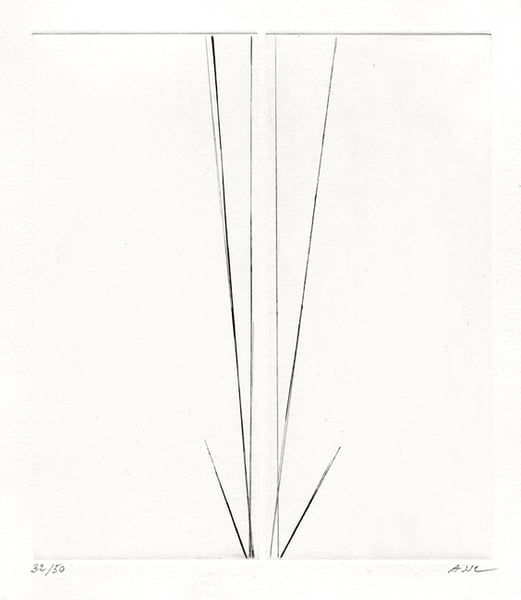
Geneviève Asse (1923–2021) occupies a distinctive position within 20th-century abstraction, bridging the rigorous geometry of American Minimalism with the luminous, atmospheric sensibility of French peinture pure. La pointe de l'oeil—the title translating to "the tip of the eye" or "point of sight"—exemplifies her lifelong investigation into the limits of perception and the threshold between figure and ground.
Stylistic Significance within Minimalism
While Minimalism is often associated with hard-edge industrial materials and bold, declarative forms (e.g., Donald Judd, Ellsworth Kelly), Asse’s practice introduces a meditative, almost breath-like quality to the movement. Her works, typically executed on canvas in muted, near-monochromatic palettes of pale blues, greys, and whites, reject brashness in favor of nuanced tonal gradation. In La pointe de l’oeil, this manifests as a delicate horizontal or vertical division—often a single seam of light where two subtly different fields meet.
The “point of the eye” is literal: Asse was fascinated by the foveal region of vision, where clarity is sharpest, and by the peripheral blur that frames it. The painting thus becomes a sensory field that resists easy focal resolution, forcing the viewer to shift between attentive looking and ambient awareness. This aligns her with the phenomenological Minimalism of Robert Ryman or Agnes Martin, but Asse’s touch is distinctly her own—cool, elegant, and inflected with the quiet architecture of her native Brittany’s coastal light.
The Work’s Contribution to Abstract Language
Asse’s abstraction is never purely reductive. Instead, it operates through absence as presence: the white or blue-gray expanses are not empty but rather charged with the memory of gesture. She frequently applied paint in thin, layered washes (taches), allowing the canvas weave to remain visible—a technique drawn from the Art Informel yet disciplined by Minimalist restraint. In La pointe de l’oeil, this results in a surface that breathes, shimmering at the edge of visual attention.
The artwork’s significance also lies in its feminine reframing of Minimalist logic. At a time when the movement was dominated by male artists emphasizing literal objecthood, Asse introduced an introspective, perceptual intimacy. Her “point of the eye” is not a target but a threshold—a reminder that seeing is itself an act of creation.
Legacy
Though lesser-known internationally than her American contemporaries, Asse is celebrated in France for her synthesis of Minimalist clarity and lyrical atmosphere. La pointe de l’oeil stands as a masterwork of this balance: a painting that is rigorously abstract yet deeply embodied, inviting the viewer to witness the very moment when vision becomes form. It remains a quietly radical statement on how Minimalism can be both severe and infinitely tender.
Visivamente simili
20 opere con composizione e palette affini
Untitled
Tomas Maldonado
Circus in White
O. Louis Guglielmi
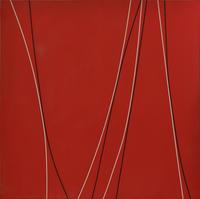
Untitled (Black and White Lines on Red Background)
Lorser Feitelson
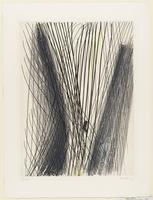
#18
Hans Hartung
Sil I
Laszlo Moholy-Nagy
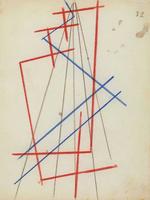
Space Force Construction
Lyubov Popova
Adriatics (A)
Brice Marden
Composition (From the ”Nice” series)
Richard Mortensen
Painting in red and black
Lygia Pape
Circus in Yellow
O. Louis Guglielmi
Quadro
Emilio Scanavino
Proun 5 A
El Lissitzky
5207 IMG 20210611 191312
MF ARLO
Komposition rotes Dreieck
Carl Buchheister
Pittura n. 3
Emilio Scanavino
Untitled
Virginia Jaramillo
Untitled
Ivan Serpa
My Space My Dimension
Funasaka Yoshisuke
Black Lines 1
Georgia O'Keeffe
Untitled
Christopher Wilmarth