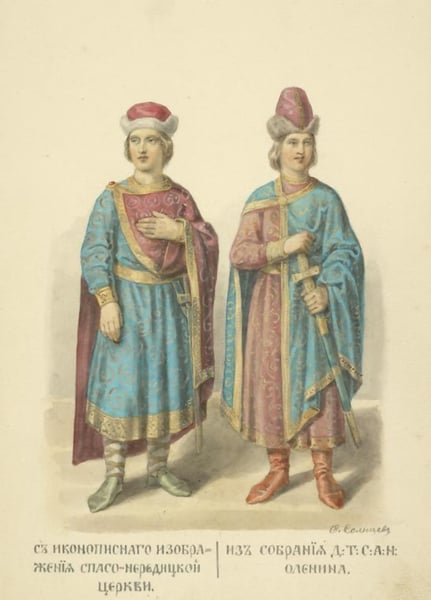
On the iconographic image of the Saviour, the Nereditskaya church
Analisi esperta di On the iconographic image of the Saviour, the Nereditskaya church di Fyodor Solntsev
Stile: Romanticism · Genere: sketch and study
Expert Analysis: "On the iconographic image of the Saviour, the Nereditskaya church" by Fyodor Solntsev
Fyodor Solntsev’s On the iconographic image of the Saviour, the Nereditskaya church is a work of singular importance within the Romantic movement, specifically in its Russian iteration. As a sketch and study, it transcends mere preparatory function to become a vital document of cultural preservation. The artwork’s significance lies in its dual role: it is both a Romantic meditation on medieval spirituality and a meticulous archaeological record of a rapidly vanishing heritage.
Stylistic and Period Significance
Solntsev, a leading figure in the Russian Romantic revival of national history, employs the sketch not as a rough draft but as a finished statement. Romanticism’s emphasis on emotion, the sublime, and the past is here channeled into an almost ethnographic reverence. The loose, expressive lines and selective detailing capture the weathered fresco of the Saviour from the 12th-century Church of the Saviour on Nereditsa Hill (near Novgorod). Instead of a polished oil painting, Solntsev chooses the immediacy of a study—a choice that heightens the viewer’s sense of encountering a fragile, authentic relic. This aligns with Romanticism’s fascination with ruin and decay as windows into a lost golden age.
Genre and Technique
As a sketch and study, the work is groundbreaking for its time: it elevates the architectural and iconographic detail to the status of fine art. Solntsev’s hand records the iconic Christ Pantocrator with a combination of academic precision and Romantic pathos. The dry brushwork and subtle washes mimic the faded condition of the original fresco, making the artwork itself a testament to the passage of time. Critics and scholars have noted that this study was part of Solntsev’s larger mission—commissioned by the Russian government—to document and publish ancient Russian monuments (notably in the multi-volume Antiquities of the Russian State). Thus, the sketch is both an artwork and a primary source for art history.
What Makes It Significant
The painting’s true significance emerges from its context: the original frescoes of Nereditsa were destroyed during World War II. Solntsev’s study remains one of the few accurate visual records of the church’s original iconographic program. In this sense, the artwork is a bridge between Romanticism’s sentimental historiography and modern conservation. It proves that a Romantic sketch can carry the weight of historical truth—capturing not just an image, but a world view that was on the brink of extinction. For art historians, it exemplifies how Russian Romanticism used archival methods to forge a national identity, making this modest study a keystone in the history of both art and heritage.
Visivamente simili
20 opere con composizione e palette affini

From Svyatoslav's snornik
Fyodor Solntsev
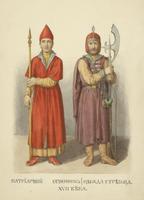
Patriarchal ognennik.Clothes of Archer.
Fyodor Solntsev
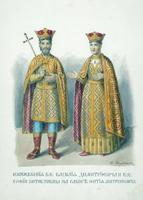
Images of the VC. Vasily Dmitrievich and VC. Sofia Vitovtovna
Fyodor Solntsev
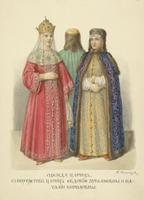
Clothing of queens. With portraits of queens Evdokia Lukianovny and Natalia Kirilovna
Fyodor Solntsev
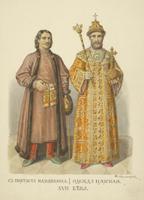
From portrait of the Naryshkin. Royal Clothing
Fyodor Solntsev

From Nereditskaya Church
Fyodor Solntsev

Royal Clothing of the XVII century. The image of Tsar Fedor Alekseevich
Fyodor Solntsev
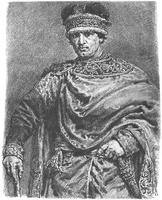
Wladyslaw II the Exile
Jan Matejko
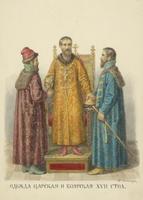
Royal and nobleman clothing of the XVII century
Fyodor Solntsev

Stephan IV
Josef Kriehuber
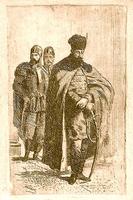
Michael the Brave
Theodor Aman
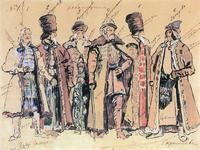
Prince Golitsyn and the boyars
Konstantin Korovin
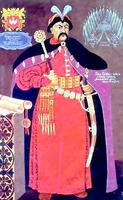
Portrait of B. Khmelnitsky
Heorhiy Narbut
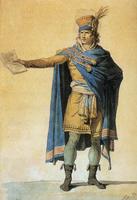
The Representatives of the People on Duty
Jacques-Louis David
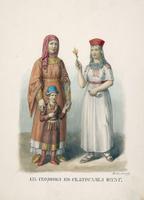
From Svyatoslav's snornik
Fyodor Solntsev
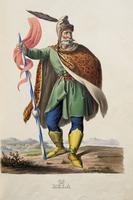
Bela
Josef Kriehuber

Find
Sergey Solomko
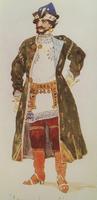
Mizgir
Viktor Vasnetsov

Bela III
Josef Kriehuber

Bela IV
Josef Kriehuber