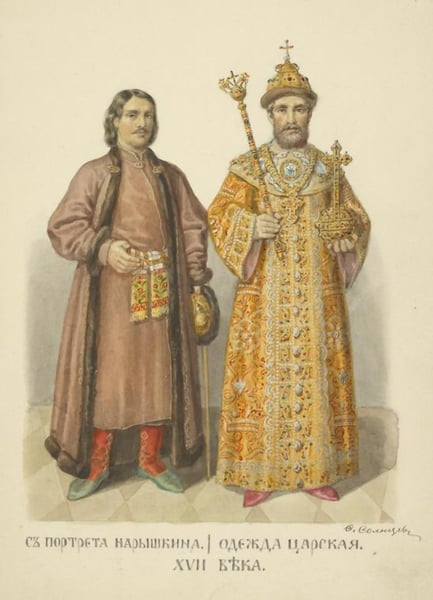
From portrait of the Naryshkin. Royal Clothing
Analisi esperta di From portrait of the Naryshkin. Royal Clothing di Fyodor Solntsev
Stile: Romanticism · Genere: sketch and study
This work, From portrait of the Naryshkin. Royal Clothing by Fyodor Solntsev, holds a distinctive place within the Romantic movement due to its dual role as both a meticulous historical document and a creative expression of national identity. Executed as a sketch and study, the piece exemplifies Romanticism’s deep fascination with the medieval and early modern past—in this case, the opulent regalia of Russian royalty.
Significance within Romanticism and its period:
-
National Romanticism and the “Russian Style”: Solntsev was a central figure in the 19th-century revival of Russian historical imagery. His detailed studies of royal garments, such as this one based on a portrait of the Naryshkin family, helped define the visual vocabulary of the “Russian Style” that became integral to Romantic-era nationalism. By focusing on authentic fabrics, embroidery, and ornamentation, Solntsev elevated a costume study from mere illustration to an artifact of cultural memory.
-
Blending Art and Archaeology: Unlike many Romantic painters who idealized the past, Solntsev approached his subject with the rigor of an archaeologist. This study is part of his larger project to record and preserve the material culture of pre-Petrine Russia—a period Romantics saw as a golden age of authentic national spirit. The sketch’s unfinished, preparatory quality underscores the artist’s process of close observation, making it a rare window into how Romantic artists balanced historical accuracy with artistic sensitivity.
-
Symbol of Imperial Power: The “royal clothing” depicted is not simply costume; it is loaded with symbolic meaning. The elaborate textiles, rich with gold thread and precious stones, signify the divine right and opulence of the monarchy. In the Romantic imagination, such attire embodied the mystery, splendor, and hierarchical grandeur of a lost world—a key preoccupation for artists seeking to evoke emotion and awe.
-
Influence on Decorative Arts and Theater: Solntsev’s studies directly informed stage designs, ceremonial costumes, and even official court dress later in the 19th century. This artwork thus transcends its sketchbook origins to become a foundational reference for Romantic-era visual culture, bridging fine art, fashion, and historiography.
In summary, From portrait of the Naryshkin. Royal Clothing is significant not because it is a finished Romantic tableau, but because it captures the Romantic ethos in its purest form: a passionate, scholarly, and reverent gaze into the nation’s past, rendered with the immediacy of a study that feels both authentic and alive. It stands as a testament to Solntsev’s role in shaping how Russia visualized its own history during the Romantic period.
Visivamente simili
20 opere con composizione e palette affini
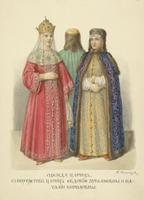
Clothing of queens. With portraits of queens Evdokia Lukianovny and Natalia Kirilovna
Fyodor Solntsev
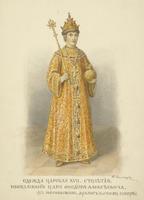
Royal Clothing of the XVII century
Fyodor Solntsev
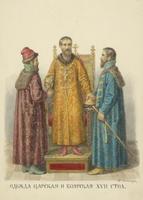
Royal and nobleman clothing of the XVII century
Fyodor Solntsev
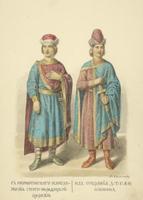
On the iconographic image of the Saviour, the Nereditskaya church
Fyodor Solntsev
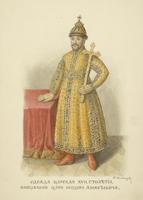
Royal Clothing of the XVII century. The image of Tsar Fedor Alekseevich
Fyodor Solntsev
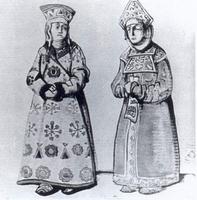
Sketch of costumes for "Snow Maiden"
Nicholas Roerich
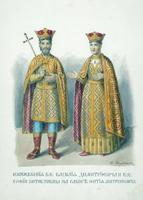
Images of the VC. Vasily Dmitrievich and VC. Sofia Vitovtovna
Fyodor Solntsev
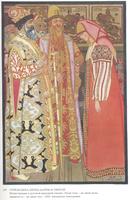
Illustration for the fairytale "Go there do not know where, bring it I do not know what"
Ivan Bilibin
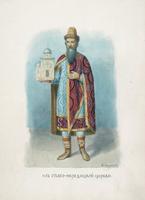
From Nereditskaya Church
Fyodor Solntsev
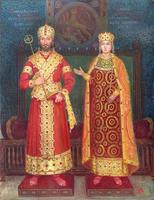
Konstantin and Irina
Anton Mitov
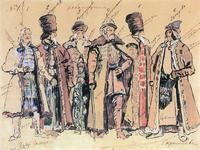
Prince Golitsyn and the boyars
Konstantin Korovin
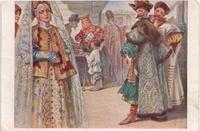
Meeting
Sergey Solomko
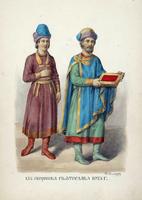
From Svyatoslav's snornik
Fyodor Solntsev
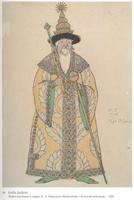
Sketch for the Opera, The Golden Cockerel, by Nikolai Rimsky-Korsakov
Ivan Bilibin
Boyarin and boyarynia
Nicholas Roerich
From the wedding of Tsar Mikhail Fedorovich
Fyodor Solntsev
Wise King Berendey
Viktor Vasnetsov
Mizgir
Viktor Vasnetsov
Elizabeth of Luxembourg
Josef Kriehuber
Emperor Charlemagne
Albrecht Durer