
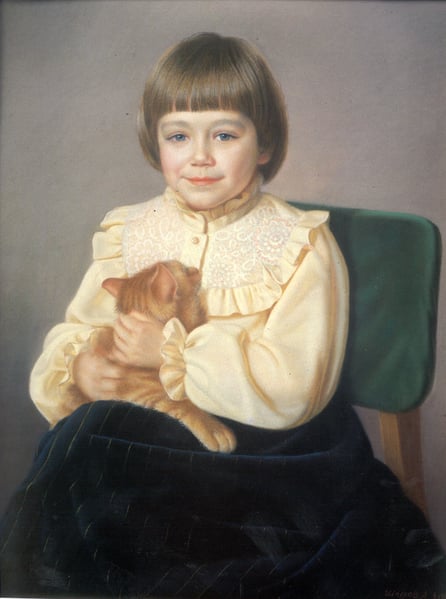
Expert analysis of Alexander Shilov’s Violet with the cat
Style: Kitsch, Romanticism · Genre: portrait
Analysis of "Violet with the cat" by Alexander Shilov
Alexander Shilov’s "Violet with the cat" is a portrait that exemplifies the intersection of Kitsch and Romanticism, two styles that, while often seen as opposing poles of artistic value, converge here in a deliberate and technically accomplished manner. The work’s significance lies in how it deploys the conventions of Romantic portraiture—emotional intensity, idealized innocence, and a focus on the intimate bond between human and nature—but reframes them through the lens of Kitsch, a style that embraces sentimentality and mass appeal.
Stylistic Significance within Kitsch and Romanticism
-
Romanticism’s influence is evident in the tender, almost ethereal treatment of the subject. The child “Violet” is depicted with soft, glowing light that hallows her features, a hallmark of Romantic portraiture that elevates childhood to a symbol of purity and spiritual connection. The presence of the cat—a classic companion in Romantic art—reinforces the theme of harmonious coexistence with the natural world, a nod to the Romantic ideal of the “noble innocent.”
-
Kitsch’s role transforms this Romantic vocabulary into something accessible and emotionally immediate. Shilov’s hyper-realistic rendering of textures (the fur of the cat, the fabric of Violet’s dress, the gleam in her eyes) is technically virtuosic, yet the composition is deliberately composed to provoke a sentimental response. The sweetness of the scene, the large-eyed gaze of the child, and the uncomplicated tenderness between girl and animal are unmistakably Kitsch—designed to be universally appealing rather than intellectually challenging. This is not a critique but a defining feature: Shilov’s work shows that Kitsch can be executed with the same precision as academic realism, blurring the line between high and low art.
Significance Within Shilov’s Oeuvre and the Period
Shilov is a leading figure in contemporary Russian portraiture, and "Violet with the cat" epitomizes his signature approach: a fusion of Socialist Realist technical discipline (learnt from his training at the Moscow State Academic Art Institute) with a post-Soviet, commercially successful sentimentalism. The painting’s significance lies in its ability to resonate with a broad public, especially in Russia, where such idealized childhood imagery satisfies a cultural longing for stability, warmth, and traditional values after decades of political upheaval.
-
Cultural resonance: The portrait bypasses modernist irony or abstraction, instead offering a safe, emotionally rewarding visual experience. This makes it a key example of how Kitsch enters high art—not through parody, but through earnest deployment. Art historians often note that Shilov’s popularity stems from his ability to make viewers feel “seen” and comforted, a function that high-art Romanticism also once served for its 19th-century audience.
-
Technical mastery as content: The painting’s significance also rests on its sheer realist accuracy. The cat’s fur, the child’s dappled skin tones, and the subtle play of light are rendered with a near-photographic precision that commands respect even from critics of Kitsch. This mastery elevates the work beyond mere decoration, allowing it to function as a contemporary reimagining of Romantic portraiture—one that deliberately courts emotional simplicity in a complex age.
Conclusion
"Violet with the cat" is significant because it embodies a conscious, skilled synthesis of Romantic ideals and Kitsch sensibility. It challenges the art world’s traditional dismissal of Kitsch by demonstrating that technical prowess and genuine emotional appeal can coexist. For viewers, the painting stands as a testament to the enduring power of innocent imagery in an era of irony and fragmentation. Shilov’s portrait is not just a girl with a cat—it is a cultural artifact that reveals how contemporary art can still find profound meaning in simplicity, sentiment, and the timeless bond between human and animal.
Genre
Style
Visually similar
20 works with related composition and palette

Leticia
Richard Whitney
Child with doll
Albrecht Anker
Portrait of Jean Renoir (Child with a Hoop)
Pierre-Auguste Renoir
Best friends forever
Pericles Pantazis
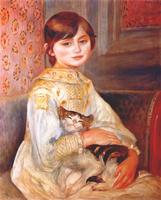
Child with Cat (Julie Manet)
Pierre-Auguste Renoir
Portrait of Tilemahos Gyzis
Nikolaos Gyzis
Portrait of a Young Girl with a Blue Ribbon
Louise Abbéma
Mädchenbildnis mit Puppe
Vaclav Brozik

Olga Leznik
Alexander Shilov
Girl with a Doll
Zinaida Serebriakova
Portrait of a Girl
Józef Mehoffer
Portrait of a Girl in Black
George Luks
Portrait of the young de Bros
Albrecht Anker
Portrait of Dorothy
William Merritt Chase
Pierre Bracquemond as child
Marie Bracquemond
Her best friend
Émile Munier
Portrait of Adolphine Købke, Sister of the Artist
Christen Kobke
Portrait of a child
Edward R. Taylor
Portrait of Emilie Weiss
Albrecht Anker
Portrait of Marjorie Coldwell Westinghouse
Frank W. Benson