Expert analysis of Auguste Herbin’s Women and Children
Style: Cubism · Genre: portrait
Expert Analysis: "Women and Children" by Auguste Herbin
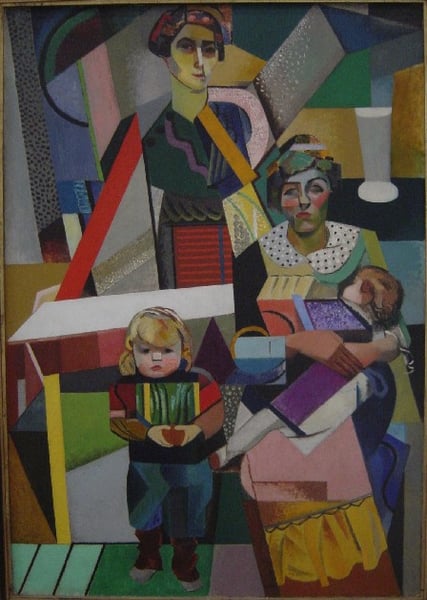
Auguste Herbin’s Women and Children stands as a compelling example of early 20th‑century Cubist portraiture, reflecting the movement’s core ambitions while also hinting at Herbin’s later transition toward pure abstraction. Although the work is categorized as a portrait, Herbin, like his fellow Cubists, subverts traditional representation by fracturing the human figure into a mosaic of geometric planes. The title’s plural subjects are likely distilled into a single, multifaceted composition—a typical Cubist strategy that conflates multiple viewpoints into one unified picture plane.
Significance within Cubism:
-
Structural Fragmentation and Reassembly: Herbin employs the Cubist lexicon of interlocking facets, sharp angles, and subdued, earthy tones (ochres, grays, blues) to break apart the forms of women and children. This approach prioritizes the painting’s two‑dimensional surface over illusionistic depth, aligning with the radical aims of Analytical Cubism.
-
Synthesis of Figure and Ground: In Women and Children, the figures are not merely set against a background; they merge with it. Herbin distributes lines and planes across the canvas so that negative spaces become as active as the subjects themselves, creating a rhythmic, allover composition that prefigures his later non‑objective works.
-
Contribution to the Section d’Or: As a key member of the Section d’Or group (alongside artists like Villon, Kupka, and Picabia), Herbin helped push Cubism toward a more systematic, almost mathematical ordering of form. Women and Children exhibits this rational structure—each angled plane seems calculated to hold its place in a dynamic grid, lending the portrait a sense of architectural stability.
-
Bridge to Abstract Art: While firmly rooted in Cubist portrait conventions, the painting’s emphasis on flat, abstracted geometry over naturalistic likeness foreshadows Herbin’s later shift to pure abstraction. The “women and children” become ciphers for shape and color relationships, marking an important step in the evolution from representational Cubism to the geometric abstraction that would define much of Herbin’s career.
In summary, Women and Children is significant not only as a skillful Cubist portrait that captures the movement’s hallmark fragmentation and multiple perspectives, but also as a document of Herbin’s personal trajectory—one that ultimately led him away from figuration and into a pioneering role in abstract art. The work exemplifies how Cubism’s formal innovations could simultaneously serve portraiture’s human subject while dismantling its very conventions.
Visually similar
20 works with related composition and palette
Women and Children
Auguste Herbin
Seated Woman with Child (Motherhood)
Amedeo Modigliani
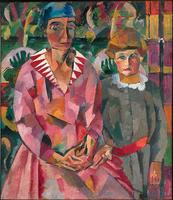
Portrait of Artist's Wife and Daughter
Aristarkh Lentulov
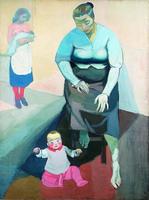
Mothers
Andrzej Wróblewski
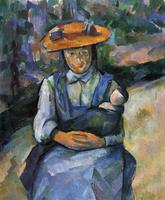
Little Girl with a Doll
Paul Cezanne
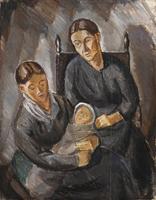
Isoäiti
Sallinen Tyko
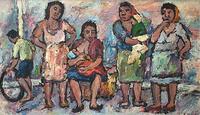
Mothers and Babies
Kenneth Baker
Czobel Bela Petite Fille a La Poupeé 1964
Bela Czobel
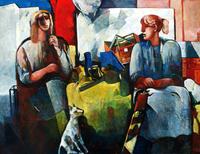
Models
Rudolf Bér
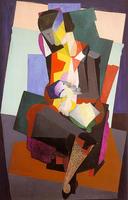
Motherhood Angelina and the Child Diego
Diego Rivera
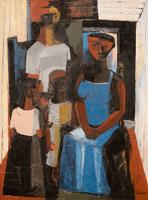
The Family
Charles Alston
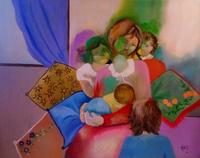
My Family
Maria Pia Solito Valerio (PiVal)
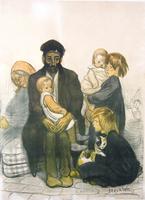
Le Locataire
Theophile Steinlen
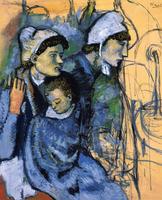
Woman at a Fountain
Pablo Picasso
Gypsies with Sunflowers
Otto Mueller
Figures in a Landscape at Ampurdan
Salvador Dali
Tahitian woman and two children
Paul Gauguin
Girl with Cat II
Franz Marc
Kauppiaan Tyttäret
Sallinen Tyko
Maternity
Henri Catargi