Analisi esperta di Indigo di Al Held
Stile: Op Art · Genere: abstract
Expert Analysis: "Indigo" by Al Held
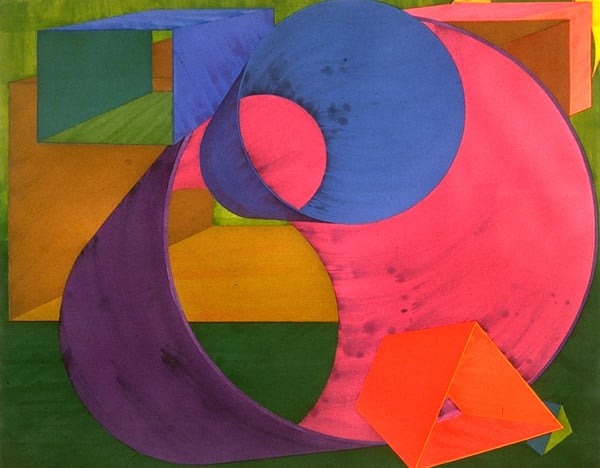
Al Held’s "Indigo" is a striking example of Op Art abstraction, a movement that emerged in the mid-20th century and sought to challenge the viewer’s visual perception through rigorous geometric patterning and optical effects. While specific details about the composition (such as medium or dimensions) are not provided, the title—Indigo—offers a key interpretive clue: the deep, saturated blue-violet hue likely dominates the work, engaging directly with the optical properties of color contrast, afterimage, and spatial ambiguity that define Op Art.
Significance within Op Art and Abstract Traditions:
-
Optical Dynamics and Perceptual Play
Held, a leading figure in hard-edge abstraction and later Op Art, utilized precise, often interlocking geometric forms to create a sense of movement, vibration, or depth. In Indigo, the titular color likely functions as both a focal point and a perceptual trap: indigo’s position on the visible spectrum (between blue and violet) can appear to advance or recede depending on surrounding tones, a classic Op Art strategy. By isolating or juxtaposing this hue with complementary colors (e.g., yellow-orange) or with black and white, Held would generate flickering afterimages and illusory motion—hallmarks of the style. -
Rigorous Abstraction and Formal Purity
Unlike some Op artists who incorporated representational or biomorphic forms, Held remained committed to pure geometric abstraction. His works, including Indigo, are devoid of narrative or figurative reference, relying entirely on the interplay of line, shape, and color to activate the viewer’s retina. This places Indigo within a lineage of post-painterly abstraction that values flatness, sharp edges, and systematic composition. Held’s method often involved mathematical grids or modular units, emphasizing order and control—yet the optical result is one of instability and dynamic tension. -
Contribution to the Op Art Movement
While Op Art is most famously associated with Victor Vasarely and Bridget Riley, Al Held’s contribution lies in his fusion of hard-edge precision with large-scale, immersive spatial illusions. Indigo exemplifies how Op Art can transcend mere “trick” effect to become a rigorous investigation of visual cognition. Held’s work anticipates later developments in digital and generative art by treating the canvas as a field of data to be processed by the eye—a process that Indigo makes both visceral and intellectually engaging.
What Makes Indigo Exceptional:
-
Color as Structure: The focus on a single, powerful hue (indigo) suggests a monochromatic or limited palette, forcing the viewer to attend to subtle variations in value, transparency, and edge interactions. This discipline aligns with Held’s later “optical” paintings of the 1970s, where bold primary colors and stark black outlines produced vibrating, almost sculptural forms.
-
Psychological Impact: Indigo carries associations with depth, contemplation, and the infinite—qualities that resonate with the Op Art goal of destabilizing the boundary between the real and the perceived.
In summary, "Indigo" is significant not only as a representative work of Al Held’s mature Op Art phase but also as a testament to the movement’s core ambition: to make visible the act of seeing itself. By channeling abstraction through relentless geometric order and interactive color, Held transforms a simple shape-and-color arrangement into a living, kinetic experience.
Visivamente simili
20 opere con composizione e palette affini
Orion II
Al Held
Pachinko
Al Held
Prime Moments II
Al Held
Shakespearean Equation: Measure For Measure
Man Ray
Contrast of Forms
Fernand Leger
Crystals
George Saru
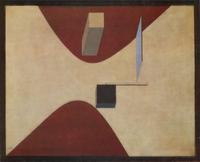
Proun 23, No.6
El Lissitzky
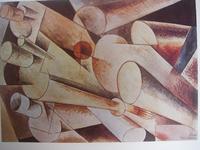
Marchers
Sandor Bortnyik
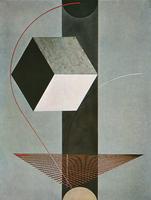
Proun 99
El Lissitzky
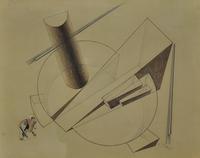
Sketch of Scenery for the Opera 'Valkyrie'
Alexander Khvostenko-Khvostov
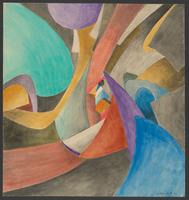
Colored Rhythm: Study for the Film
Leopold Survage
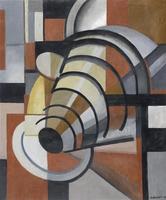
Futorismo
Gustave Buchet
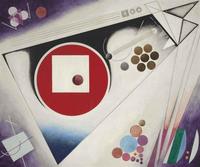
Third Symphony in 3 Movements
Rudolf Bauer
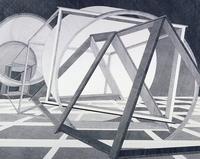
Straits of Malacca
Al Held
Proun
El Lissitzky
Topological Contortion of a Female Figure
Salvador Dali
Abstract No. 7
Lawren Harris
Colour circle
August Macke
Composition
Vasile Dobrian
Sketch for the ballet by Igor Stravinsky: Fireworks (Feu d'artifice)
Giacomo Balla