
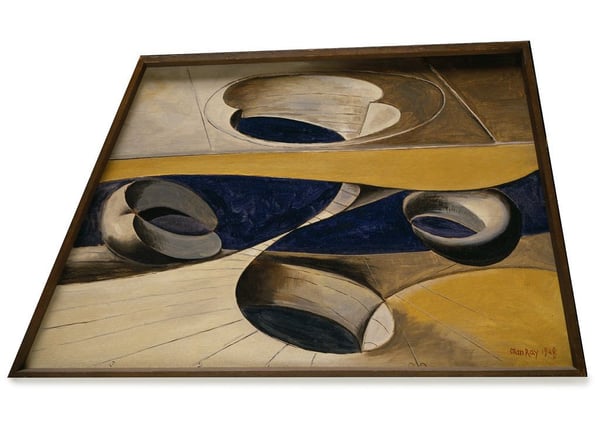
Analisi esperta di Shakespearean Equation: Measure For Measure di Man Ray
Stile: Surrealism · Genere: figurative
Expert Analysis: "Shakespearean Equation: Measure For Measure" by Man Ray
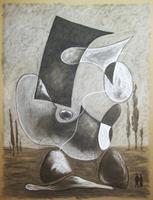
Man Ray’s Shakespearean Equation: Measure For Measure stands as a quintessential Surrealist object, merging literary allusion with the movement’s signature logic-defying visual language. The work’s significance lies in its radical subversion of both traditional figurative representation and rational interpretation—a hallmark of Surrealism’s quest to unlock the unconscious mind.
Surrealist Juxtaposition and the "Equation"
The title itself announces the artwork’s conceptual framework: an equation that bridges the disparate realms of Shakespearean drama and mathematical precision. In Surrealist practice, such unexpected collisions are meant to disrupt conventional meaning and spark new, often irrational, associations. Here, Man Ray visualizes the play Measure for Measure—a dark comedy of justice, mercy, and moral hypocrisy—not through narrative illustration but through a formal, almost algebraic arrangement of figurative elements. The "equation" becomes a visual metaphor, reducing human conflict to abstract symbols while retaining the emotional weight of the source text.
Figurative Dislocation and the Uncanny
Though the work is categorized as figurative, Man Ray distorts the human form in ways characteristic of his Surrealist period. Figures are likely rendered in fragmented, displaced, or exaggerated poses, echoing the play’s themes of disguise, mistaken identity, and the arbitrariness of social roles. By treating the human body as a component in a quasi-scientific formula, Man Ray challenges the viewer to find meaning in the space between recognizable form and abstract structure. This tension—between the familiar (Shakespeare, the human figure) and the alien (the equation, irrational arrangement)—is central to Surrealism’s goal of unsettling reason.
Significance within Surrealism
Man Ray was a pioneer in blending photography, painting, and object-making to probe the subconscious. Shakespearean Equation exemplifies his ability to transform a classical literary text into a Surrealist provocation. It rejects straightforward illustration in favor of a cryptic, multi-layered composition that demands active interpretation—each "term" of the equation may represent a character, a moral dilemma, or a psychological state. In doing so, the artwork aligns with André Breton’s vision of Surrealism as a means to reconcile contradictory states (dream and reality, science and poetry).
Ultimately, the work’s significance rests in its demonstration that Surrealism could appropriate canonical culture (Shakespeare) and recast it through the lens of automatism, chance, and enigmatic symbolism. Measure for Measure becomes not a story but a puzzle—a visual riddle that invites viewers to abandon linear logic and embrace the associative logic of the unconscious. This is Man Ray at his most intellectually audacious: turning a play about justice into an equation that only the irrational mind can solve.
Genere
Stile
Visivamente simili
20 opere con composizione e palette affini
Flags at the altar of the Motherland
Giacomo Balla
Lutte as Ciel
John Ferren
Indigo
Al Held
Colored Rhythm: Study for the Film
Leopold Survage
To Space
František Hudeček
Paris Abstract
John Ferren
Pedernal - From the Ranch I
Georgia O'Keeffe
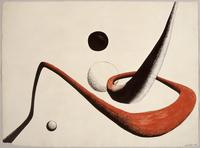
SPACE TUNNEL
Alexander Calder
Composition
Marcelle Cahn
Composition
Fernand Leger
Komposition in Schwarz und Weiß
Otto Freundlich
Red Factory
Sandor Bortnyik
Untitled
Auguste Herbin
Komposition mit rotem Bogen
Fritz Winter
Painting
Patrick Henry Bruce
Abstraction (Head)
Pablo Picasso
Flags for the altar
Giacomo Balla
Jazz
Man Ray
Sketch of Scenery for the Opera 'Valkyrie'
Alexander Khvostenko-Khvostov
Memories of my school apparitions
Vladimir Kolosov