
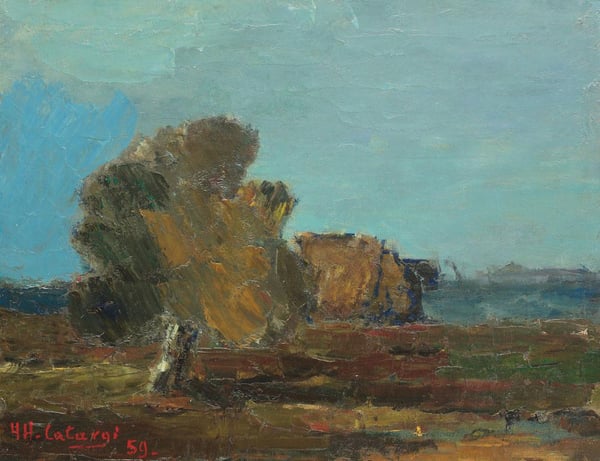
Analisi esperta di Landscape in Arges Valley di Henri Catargi
Stile: Impressionism · Genere: landscape
Expert Analysis: "Landscape in Arges Valley" by Henri Catargi
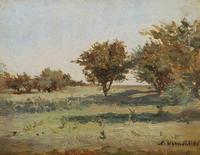
Henri Catargi’s Landscape in Arges Valley stands as a compelling example of how Impressionist principles were adapted to the specific light, topography, and cultural context of early 20th-century Romania. While the artwork is firmly rooted in the Impressionist tradition—emphasizing plein-air observation, broken color, and atmospheric effects—its significance lies in its role as a bridge between Western European avant-garde painting and the Eastern European landscape tradition.
Key elements of significance:
-
Regional Impressionist Innovation: Catargi was among the first Romanian painters to consistently apply Impressionist techniques to the Carpathian landscape. The Arges Valley, with its dramatic terrain and shifting light, provided a non-traditional subject for the movement, which had previously been associated with rural France (Monet’s haystacks, Renoir’s dappled gardens). By grounding Impressionist methods in a distinctly Romanian locale, Catargi helped legitimize a national school of modern landscape painting.
-
Mastery of Atmosphere and Color: True to Impressionist doctrine, the work likely captures a fleeting moment—perhaps the soft haze of a humid valley morning or the golden glow of late afternoon. Catargi’s palette would have emphasized the vibrant greens of the valley’s forests, the silvery blues of the Arges River, and the warm ochres of exposed earth. The significance here is his ability to transcribe the subtle, humid light of the sub-Carpathian region, which differs markedly from the brighter, more diffuse light of coastal France. This regional specificity elevates the painting beyond a mere imitation of Monet or Sisley.
-
Synthesis of Tradition and Modernity: Although Impressionist in style, Catargi’s composition likely retains a structured sense of depth and scale typical of Eastern European landscape painting—focusing on the valley’s dramatic recession into the mountains. This synthesis made Impressionism accessible to Romanian audiences while still challenging academic conventions. The work thus marks a pivotal moment in the modernization of Romanian art, where local identity meets international technique.
In summary, Landscape in Arges Valley is significant not only as a fine example of Impressionist landscape painting but also as a cultural artifact that demonstrates how a global movement can be re-rooted in a specific geography, enriching both the style and the national artistic heritage.
Genere
Stile
Visivamente simili
20 opere con composizione e palette affini
Brăneşti Landscape
Adam Baltatu
La Plaine Aux Environs De Rolleboise
Maximilien Luce
Cagnes Landscape
Pierre-Auguste Renoir
Late Afternoon
Robert Julian Onderdonk
Landscape with grey sky
Thomas Pollock Anshutz
Landscape with Birches
Konstantin Yuon
Sunlit Hillside
Robert Julian Onderdonk
Egry József, Balatoni Táj
Egry József
The field
Nicolae Tonitza
Argeș Valley
Adam Baltatu
Landscape
Edward Mitchell Bannister
Twilight
Pyotr Konchalovsky
Texas Dry Country
Robert Julian Onderdonk
The Road and the House
Claude Monet
Landskap met kronkelende pad, Kenilworth
Gregoire Boonzaier
Summer Landscape
Stefan Dimitrescu
Landscape
Xavier Martinez
Landscape
Sergiy Grigoriev
SUNSET AT ST. DOULOUGH'S, MALAHIDE (HOME OF THE ARTIST)
Nathaniel Hone the Younger
Summer Day
Nicolae Vermont