
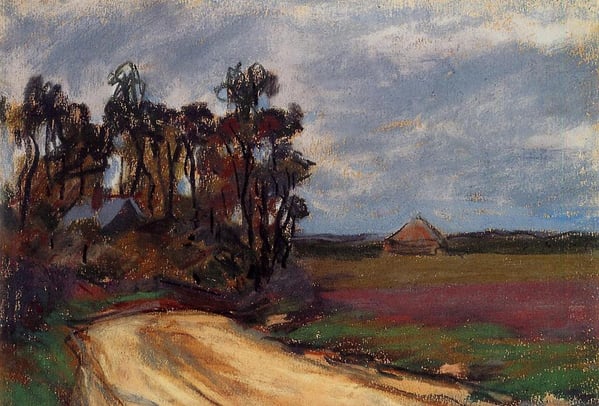
Analisi esperta di The Road and the House di Claude Monet
Stile: Impressionism · Genere: landscape
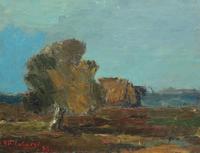
Based solely on the provided structured facts, the significance of Claude Monet’s The Road and the House lies in its embodiment of core Impressionist principles within the landscape genre. As an Impressionist work, the painting would prioritize the transient effects of light and atmosphere over precise topographical detail. The depiction of a common, unremarkable subject—a road leading to a house—reflects the movement’s break from academic history painting, elevating ordinary rural or suburban scenes to the status of fine art. The style’s hallmark loose brushwork and emphasis on color perception would transform the road and house into a study of shifting light, shadow, and weather, making the experience of seeing the scene as important as the scene itself. This focus on immediate visual sensation, rather than narrative or allegorical meaning, is what makes the landscape significant within the Impressionist canon.
Visivamente simili
20 opere con composizione e palette affini
Landscape with grey sky
Thomas Pollock Anshutz
Landscape
Konstantin Yuon
Autumn evening. Trail in the forest.
Isaac Levitan
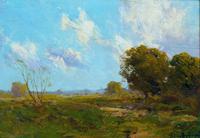
Late Afternoon
Robert Julian Onderdonk
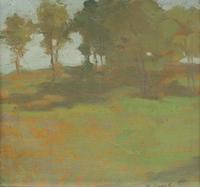
Summer Landscape
Stefan Dimitrescu
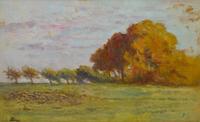
La Plaine Aux Environs De Rolleboise
Maximilien Luce
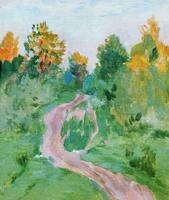
Path
Isaac Levitan
Path in the Country
Charles Angrand
The Farm
Pierre-Auguste Renoir
Landskap met kronkelende pad, Kenilworth
Gregoire Boonzaier
Landscape
Armando Montaner Valdueza
The Hedge (also known as The Clearing)
Georges Seurat
Summer Landscape
Henri Catargi
Connecticut Landscape
John Henry Twachtman
Landscape with windswept trees
Vincent van Gogh
Evening. Path.
Isaac Levitan
Three Trees
John Henry Twachtman
On the field
Teodor Harșia
A View of Templestowe
Arthur Streeton
Landscape in Arges Valley
Henri Catargi