Expert analysis of Yayoi Kusama’s Yellow Pumpkin
Style: Art Brut, Pop Art · Genre: figurative
Expert Analysis of "Yellow Pumpkin" by Yayoi Kusama
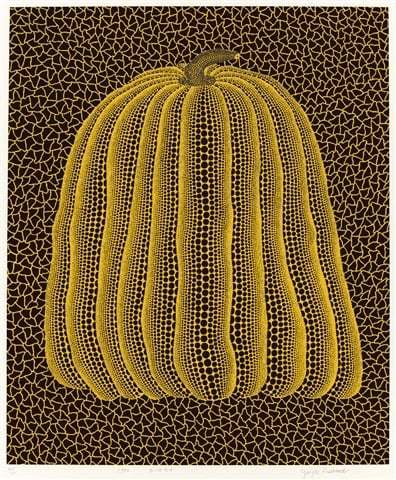
Yayoi Kusama’s Yellow Pumpkin stands as a landmark work that masterfully fuses the raw, introspective impulse of Art Brut with the vibrant, consumer-conscious vocabulary of Pop Art. The subject—a simple, biomorphic pumpkin rendered in a brilliant yellow patterned with bold black polka dots—is simultaneously a deeply personal symbol and a universally recognizable icon.
Significance within Art Brut and Pop Art
From the perspective of Art Brut (or “outsider art”), Kusama’s practice is rooted in obsessive repetition and hallucinatory vision. Her compulsive covering of surfaces with polka dots is a direct manifestation of the perceptual disturbances she has experienced since childhood—a way to “obliterate” her surroundings and cope with mental distress. The pumpkin, a recurring motif in her work, recalls a formative memory of seeing a giant pumpkin in her grandfather’s farm, which she describes as speaking to her with “an ungainly, endearing charm.” This intensely personal, almost therapeutic origin associates the work with Art Brut’s emphasis on untrained, raw expression arising from psychological necessity.
Simultaneously, the work operates squarely within Pop Art. Its bright, monochrome yellow field and crisp black dots echo the graphic simplicity of commercial signage, comic strips, and mass-produced patterns. Kusama, like Warhol or Lichtenstein, appropriates a mundane, everyday object—the pumpkin—and elevates it through bold color and repeated motif, challenging the division between high art and popular culture. The polka dots function both as a personal signature and a Pop-friendly visual gimmick that makes the image instantly memorable and reproducible.
Genre and Figurative Treatment
Though classified as figurative, Yellow Pumpkin pushes the boundaries of representation. The pumpkin is clearly recognizable, yet it is simplified to an almost cartoonish essence. The undulating ridges and stem become rhythmic lines, and the dots create a dizzying optical effect that threatens to dissolve form into pattern. This tension between figuration and abstraction is central to Kusama’s power: she gives us a familiar shape, then overwhelms it with a sensory assault that mirrors her own experience of seeing the world through a “net of polka dots.”
Broader Artistic Significance
Yellow Pumpkin is significant because it embodies Kusama’s lifelong themes—infinity, obliteration, obsession, and self-obliteration—within a single, accessible image. The work functions as a “portrait” of the artist’s psyche: the pumpkin is at once a comforting, organic form and a vehicle for infinite repetition, suggesting both growth and entrapment. Furthermore, it challenges gendered stereotypes in art history: by embracing a “feminine” domestic object (the pumpkin as food/gourd) and turning it into a monumental, obsessive icon, Kusama reclaims repetition and craft—often dismissed as “women’s work”—as high art.
Finally, the piece’s enduring popularity attests to its genius in merging the unsettling with the charming. It invites viewers into a world that is both playful and psychologically intense, making it a cornerstone of late 20th-century art that bridges the personal and the universal, the marginal and the mainstream.
Visually similar
20 works with related composition and palette
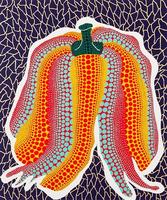
Pumpkin
Yayoi Kusama
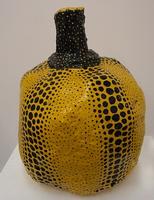
Pumpkin
Yayoi Kusama
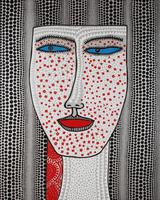
Kusama In A Foreign Country
Yayoi Kusama
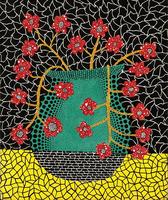
Flowers
Yayoi Kusama
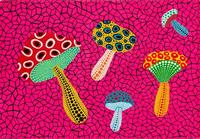
Mushrooms
Yayoi Kusama
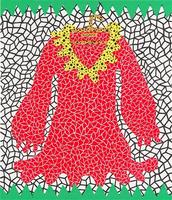
Dress
Yayoi Kusama
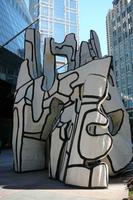
Monument with Standing Beast
Jean Dubuffet
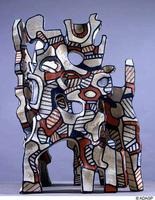
The Cosmorama IV
Jean Dubuffet
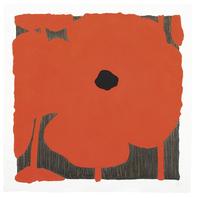
Red Flowers
Donald Sultan
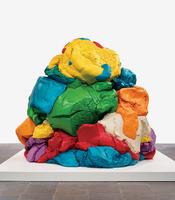
Play-Doh
Jeff Koons
View of Maya
Forrest Bess
Chick in the Shell of an Egg
Abraham Palatnik
Untitled
Aki Kuroda
Yellow Flowers
Donald Sultan
Nini the Smirker (Minaude)
Jean Dubuffet
The Peacock in the Dream
George Stefanescu
Estados Complementarios #X08
Pablo Rey
Ntange Dreaming
Emily Kame Kngwarreye
Moon (Light Pink)
Jeff Koons
Wind from stranger Breath
Chicote CFC