Expert analysis of Carlo Carra’s The Red House
Style: Metaphysical art · Genre: cityscape
Expert Analysis of "The Red House" by Carlo Carrà
Style: Metaphysical Art | Genre: Cityscape
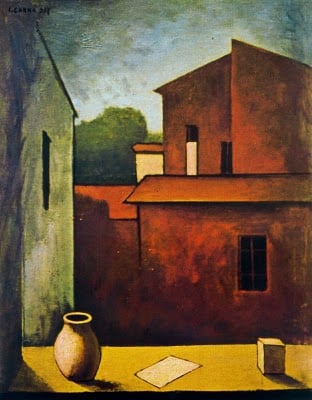
Carlo Carrà’s "The Red House" stands as a quintessential example of Metaphysical Art—a brief but influential movement that sought to transcend ordinary reality by depicting familiar objects in strange, dreamlike arrangements. As a cityscape, the work transforms the mundane urban environment into an enigmatic stage where architecture, light, and shadow conspire to evoke a sense of timeless stillness and psychological unease.
Significance within Metaphysical Art: Carrà, alongside Giorgio de Chirico, pioneered this style in the 1910s, reacting against the frenetic energy of Futurism (in which Carrà had previously participated) and instead embracing a contemplative, almost hallucinatory clarity. In The Red House, every element is charged with symbolic potential: the stark, simplified forms of buildings, the deep, unnatural shadows cast by an unseen sun, and the uncanny emptiness of the scene. The eponymous red house does not merely serve as a colorful focal point; its vivid hue contrasts with the muted, earthy tones of the surrounding structures, isolating it as a psychological anchor—simultaneously familiar and alien.
Compositional and Thematic Highlights: The composition relies on sharp, orthogonal lines and tilting perspectives that destabilize the viewer’s sense of spatial logic. Walls and roof planes seem to warp slightly, creating a disquieting friction between geometric order and irrational distortion. The absence of human figures amplifies the work’s metaphysical quality: the cityscape becomes a silent, waiting stage, where objects—windows, doorways, shadows—take on an autonomous, almost sentient presence. This emptiness invites the viewer to project meaning onto the scene, reinforcing the movement’s core idea that reality is a veil for deeper, hidden truths.
Legacy: The Red House is significant not only as a masterwork of Carrà’s metaphysical period but also as a pivotal bridge between Futurist dynamism and the later Surrealist interest in the subconscious. It demonstrates how a seemingly straightforward urban view can be transformed into a poetic, unsettling meditation on perception, memory, and the uncanny—hallmarks that continue to influence artists exploring the boundaries between the real and the imagined.
Visually similar
20 works with related composition and palette
Brazilian Landscape
Lasar Segall
Piazza del Carmine
Ottone Rosai
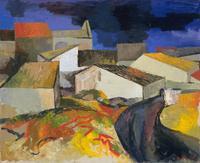
Santa Panagia (Sicily)
Renato Guttuso
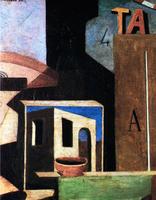
La composizione TA
Carlo Carra
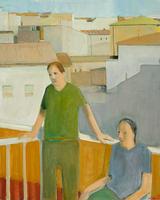
Couple on the Balcony
Henry Villierme
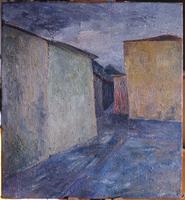
Upper Piazza
Alberto Burri
Memory of London
Lucian Freud
Il bersaglio
Carlo Carra
Yellow Porch
Richard Diebenkorn
Houses
Theophrastos Triantafyllidis
San Gimignano
Pyotr Konchalovsky
Krajina
Jindrich Styrsky
Martigues Landscape
Andre Derain
Gaberndorf II
Lyonel Feininger
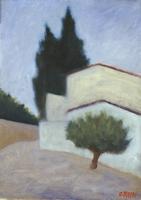
Paesaggio
Ottone Rosai
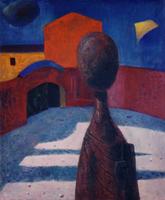
Castle Courtyard
Rudolf Láng
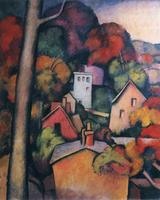
Upper Manhattan
Thomas Hart Benton
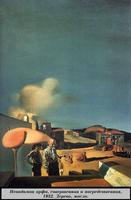
The Invisible Harp, Fine and Medium./Harpe invisible fine et moyenne
Salvador Dali
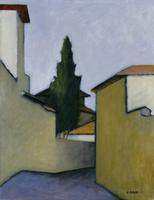
Via San Leonardo
Ottone Rosai
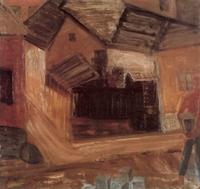
Houses with Man Carrying Stone
Istvan Ilosvai Varga