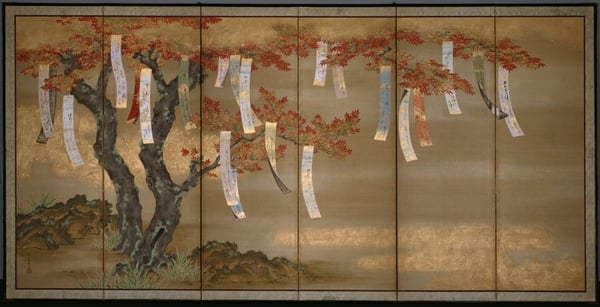
Autumn Maples with Poem Slips
Analisi esperta di Autumn Maples with Poem Slips di Tosa Mitsuoki
Stile: Yamato-e · Genere: landscape
Expert Analysis of "Autumn Maples with Poem Slips" by Tosa Mitsuoki
Style & Genre Context
This work is classified as a Yamato-e landscape, a style that emerged in Japan’s Heian period and emphasizes native Japanese subjects, decorative elegance, and poetic integration. Yamato-e landscapes often depict seasonal scenes, and here the artist focuses on autumn maples—a classic motif symbolizing transience and refined beauty.
Significance within Yamato-e
The inclusion of poem slips (tanzaku) is a hallmark of Yamato-e’s fusion of visual art and literary tradition. These poem slips, traditionally bearing waka verses, are not mere decorations but active compositional elements that connect the painted scenery to courtly poetry culture. Tosa Mitsuoki’s treatment of the maples likely uses flat, decorative color planes and delicate brushwork, characteristic of the Tosa school’s revival of classical Yamato-e during the Edo period.
What Makes It Significant
- Integration of text and image: The poem slips directly link the landscape to the Japanese poetic tradition, transforming the scene into a contemplative, multi-sensory experience.
- Seasonal focus: Autumn maples (momiji) are a quintessential Yamato-e subject, but by pairing them with poem slips, the work underscores the genre’s role in preserving aristocratic aesthetic ideals of mono no aware (the poignant beauty of impermanence).
- Stylistic consistency: As a landscape in the Yamato-e tradition, the composition likely avoids Western perspectival depth, instead using layered, asymmetrical arrangements that mirror the rhythm of poetry.
In sum, "Autumn Maples with Poem Slips" exemplifies the Yamato-e commitment to blending nature, poetry, and refined decoration, making it a significant artifact of Japan’s classical visual-literary culture.
Visivamente simili
20 opere con composizione e palette affini
Flowering Cherry with Poem Slips
Tosa Mitsuoki
Cherry trees
Tosa Mitsuoki
Cypress Trees
Kanō Eitoku
Birds and flowers in spring and autumn
Tosa Mitsuoki
琴棋書画図屏風
Kanō Motonobu
Old Pine and Cherry Trees by Rocks
Kanō Eitoku

Views Inside and Outside the Capital, Kyoto (Right half)
Kanō Eitoku
Hermits and a Fairy (Left Side)
Kanō Eitoku

Flowers and Bamboo
Xu Wei
Birds and flowers of the four seasons
Kanō Eitoku
Four Accomplishments
Kanō Motonobu
Painting on Zen Enlightenment (Sanping baring his chest and Shigong stretching his bow)
Kanō Motonobu
Illustration of the Genji Monogatari (Asagao, The Blue Bell)
Tosa Mitsuoki
Lady Xuanwen Jun Giving Instructions on the Classics
Chen Hongshou
Landscape with a Precipitous River-bank with Gnarled Pines and Three Men
Lan Ying
Hermits and a Fairy (Right side)
Kanō Eitoku
73 The City Flourishing, the Tanabata Festival
Hiroshige

Night March of a Hundred Demons (left half)
Tosa Mitsuoki
Emperor Go-Daigo
Ogata Gekko
Finches and Bamboo
Emperor Huizong