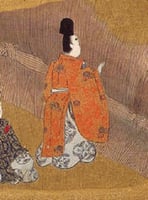

Night March of a Hundred Demons (left half)
Analisi esperta di Night March of a Hundred Demons (left half) di Tosa Mitsuoki
Stile: Yamato-e · Genere: mythological painting
Expert Art Historical Analysis: "Night March of a Hundred Demons (left half)" by Tosa Mitsuoki
This work is a masterful example of Yamato-e, the classical Japanese painting tradition that emphasizes native subject matter, refined brushwork, and decorative flatness. Executed in the mythological painting genre, it depicts a segment of the Hyakki Yagyō (Night Parade of One Hundred Demons), a folkloric trope where supernatural creatures march through the darkness.
Significance within its style and period:
-
Tosa Mitsuoki (1617–1691) was a pivotal figure who revived and codified the Tosa school, restoring Yamato-e to prominence during the Edo period. His handscrolls are known for their delicate linework, subtle color gradations, and elegant courtly sensibility—here applied to a chaotic procession of monsters, creating a striking tension between refined technique and grotesque subject matter.
-
The left half fragment implies a narrative unfolding: in a full scroll, this section would typically show the tail of the demon parade—perhaps straggling creatures or the dawn’s approach. By isolating this half, the viewer is invited to imagine the unseen earlier march, heightening the sense of mystery and movement.
-
As Yamato-e, the painting prioritizes flat, pattern-like composition over Western perspective, with demons arranged in a rhythmic, flowing line. The mythological genre allowed Mitsuoki to explore both the supernatural and the natural world (often mixing yōkai with landscapes), reinforcing the Yamato-e tradition of blending storytelling with decorative beauty.
-
This work is significant for demonstrating how late Yamato-e absorbed classical Chinese ink painting techniques while retaining distinct Japanese iconography—a hallmark of Tosa school’s legacy. The “hundred demons” theme also reveals society’s fascination with the unseen world, a core aspect of Japanese folklore that Mitsuoki elevated into high art through meticulous, patient brushwork.
Genere
Stile
Visivamente simili
20 opere con composizione e palette affini
Hermits and a Fairy (Left Side)
Kanō Eitoku
Hermits and a Fairy (Right side)
Kanō Eitoku
Four Accomplishments
Kanō Motonobu
Left Screen
Kanō Motonobu
Intimate Scenery of River and Mountains (detail)
Li Tang
琴棋書画図屏風
Kanō Motonobu
Right Screen
Kanō Motonobu
Flowers and Bamboo
Xu Wei

Intimate Scenery of River and Mountains
Li Tang
Painting on Zen Enlightenment (Sanping baring his chest and Shigong stretching his bow)
Kanō Motonobu
Views Inside and Outside the Capital, Kyoto (Right half)
Kanō Eitoku
Plum and Sparrow
Hakuin Ekaku
Untitled
Ike no Taiga
Untitled
Hélène de Beauvoir

Parting at the Jing River
Shen Zhou
Sixteen Flowers
Xu Wei
Bamboo, Rock, and Mandarin Ducks
Bada Shanren
Fly a kite
Qi Baishi
Impressive View of the Go River
Ike no Taiga
Mountain
Utagawa Kuniyoshi