
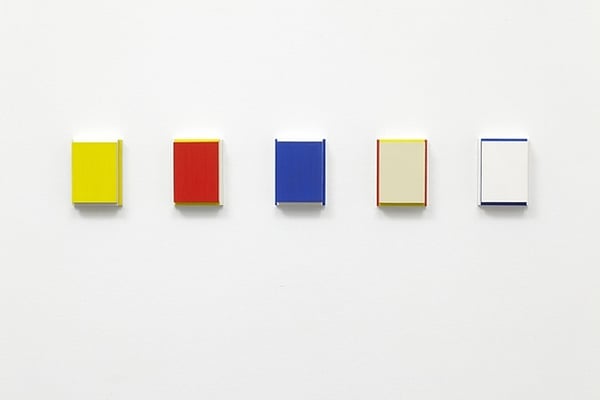
Expertenanalyse zu Imi Knoebels Tag und Nacht I F1-F5
Stil: Minimalism · Genre: abstract
Expert Analysis of Imi Knoebel’s Tag und Nacht I F1-F5 (Day and Night I F1-F5)
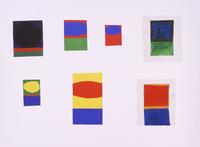
Imi Knoebel’s Tag und Nacht I F1-F5 is a seminal example of Post-War European Minimalism, embodying the artist’s relentless pursuit of purity in abstract form. Executed as a multi-panel work (indicated by the F1–F5 numbering), it reflects Knoebel’s commitment to seriality and elemental composition—hallmarks of his practice. Stylistically, the piece distills painting to its essential components: planar geometry, unmodulated color, and the physical presence of support materials. Knoebel, a student of Joseph Beuys at the Düsseldorf Academy, diverged from his teacher’s conceptual narrative, instead aligning with the reductive legacies of Russian Suprematism and Dutch De Stijl.
Significance within Minimalism and Abstraction
-
Dialectical Structure via Title and Form – The title “Tag und Nacht” (Day and Night) introduces a binary opposition—light/dark, presence/absence—that Knoebel executes through contrasting chromatic or tonal fields across the panels. This is not literal representation but a perceptual play: the viewer’s eye oscillates between panels, activating the space between them. Such dualism aligns with Minimalism’s interest in phenomenology, where meaning emerges from the viewer’s encounter rather than embedded symbolism.
-
Seriality and Objecthood – The F1–F5 designation signals a sequential investigation, a common Minimalist strategy to deconstruct composition into a series of discrete, non-hierarchical units. Each panel functions as an autonomous object, yet together they form a rhythmic, expanded field. This approach echoes Knoebel’s earlier works where he explored the “Malen ohne Malerei” (painting without painting)—emphasizing the literal surface and structure over illusionistic depth.
-
Material and Color as Subject – True to Minimalist ethos, Knoebel rejects gestural mark-making. Instead, color is applied flatly, often in stark primaries or achromatic extremes. In Tag und Nacht, the interplay of dark and light hues (presumably black/white or deep blue/white) could serve as a meditation on visual optics—how adjacent hues affect perception. The work thus becomes a site for pure visual experience, stripped of narrative.
-
Framing the Void – Knoebel’s panels frequently incorporate raw canvas or wooden edges, blurring the line between painting and sculpture. Tag und Nacht I F1-F5 likely emphasizes the interval between panels—the “negative space” that becomes as active as the painted surfaces. This spatial awareness aligns with Minimalism’s foregrounding of the artwork’s physical context, inviting viewers to consider the gallery wall itself as part of the composition.
-
Legacy and Influence – Knoebel’s work stands as a bridge between American Minimalism (e.g., Barnett Newman, Donald Judd) and European abstraction, infusing the former’s material rigor with a subtle, almost spiritual contemplativeness. Tag und Nacht I F1-F5 exemplifies his unique contribution: an art that denies expressionism while still retaining a quiet, poetic resonance—a day-and-night rhythm that is both literal and metaphorical, grounding abstraction in the most fundamental human experience of cyclic time.
Visuell ähnlich
20 Werke mit ähnlicher Komposition und Farbpalette
Grace Kelly III
Imi Knoebel

Ohne Titel
Blinky Palermo
Light
John McCracken
Hackney Road Drawing
David Batchelor
Heartbeats
Roman Cotosman
Work No. 557
Martin Creed
Sweet Pine
Anne Appleby
Work No. 373
Martin Creed

Untitled (9 - 1 - A - 17)
Yves Gaucher

18 Colors (Cincinnati)
Ellsworth Kelly
Cuarteto Rojo y Negro lateral
Cesar Paternosto
Red Yellow Blue White
Ellsworth Kelly
Green Study
Brice Marden
Coney Island II
Blinky Palermo
Ohne Titel
Blinky Palermo
Crescendo Diminuendo
Cesar Paternosto

Red Yellow Blue III
Ellsworth Kelly
Spectrum V
Ellsworth Kelly
Relief, Series B
Charlotte Posenenske
Tablet #153
Ellsworth Kelly