
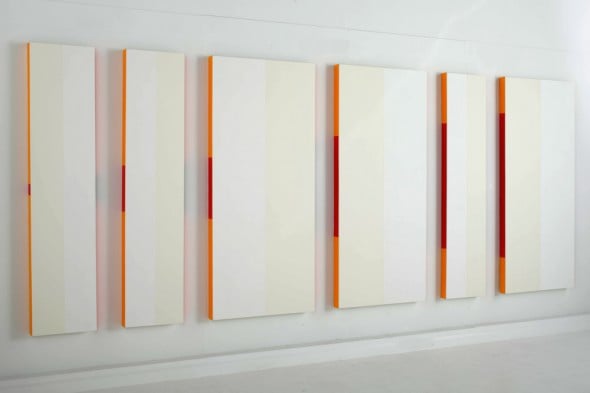
Экспертный разбор работы «Crescendo Diminuendo» художника Cesar Paternosto
Стиль: Concretism · Жанр: installation
Expert Analysis: "Crescendo Diminuendo" by Cesar Paternosto
As a work of Concretism in the installation genre, Cesar Paternosto’s Crescendo Diminuendo stands as a significant example of how geometric abstraction can be translated into immersive, spatial experience. Concretism—rooted in the mid-20th-century avant-garde—rejects all representation and emotional expression in favor of pure, rational form derived from mathematical and structural principles. Here, Paternosto extends those ideals from the two-dimensional canvas into three-dimensional space, creating an environment that is both rigorously ordered and perceptually dynamic.
The title itself is critical: Crescendo Diminuendo borrows musical terminology to describe a gradual increase and then decrease in volume. This suggests that the installation is conceived as a visual analogue to temporal, rhythmic progression. Within the concretist framework, where form is meant to be self-evident and non-referential, the use of musical metaphor is a deliberate strategy to invoke a sense of movement and change without abandoning abstraction. The work likely employs a sequence of geometric elements—possibly arranged along a path or within a room—that vary in scale, color saturation, or spatial density, creating a visual “swell” and “decay” that the viewer experiences physically as they move through the installation.
What makes Crescendo Diminuendo significant within Concretism is its embodiment of a core tension: the static, objective logic of concrete geometry versus the subjective, temporal experience of perception. While earlier concretists like Max Bill and Josef Albers focused on flat, optically active paintings, Paternosto’s installation forces the viewer to become a participant, walking through a composition that unfolds in real time. The work thus expands the concretist vocabulary by introducing a durational, almost performative dimension—the “crescendo” and “diminuendo” are not just seen but felt as a change in the viewer’s spatial relationship to pure form.
In this sense, Crescendo Diminuendo bridges the rigorous formalism of Concretism with the later concerns of Minimalism and installation art: it emphasizes the viewer’s bodily presence and the phenomenological encounter with simple, repetitive structures. By naming the work after a dynamic musical process, Paternosto underscores that even the most rational geometric system can produce a profoundly sensory and transformative experience—one that is both concrete and fluid, constant and ever-changing.
Жанр
Стиль
Визуально похожие
20 работ с близкой композицией и палитрой

Cuarteto Rojo y Negro lateral
Cesar Paternosto

Red Yellow Blue III
Ellsworth Kelly
Orange, Black Painting with Blue Edge, and Burgundy
Robert Irwin
Spectrum V
Ellsworth Kelly
Ich Nicht VIII
Imi Knoebel
The Seasons
Brice Marden
Quartetto indivisibile
Ettore Spalletti
Stations of the Cross 1958 1966
Barnett Newman
Green Study
Brice Marden
Mother E
Anne Appleby
Stanza, Giallo Oro
Ettore Spalletti
Red Alert
Hito Steyerl
Light
John McCracken

Primary Light Group: Red, Green, Blue
Jo Baer
Orison 1/2
Frederic Matys Thursz
Untitled
Friedrich Vordemberge-Gildewart
20 Part Line Painting
Alan Charlton

Capriglia
Doug Ohlson
Rezonanta
Goran Despotovski

Color Needles
Gene Davis