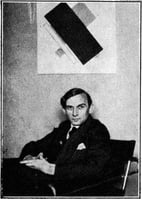
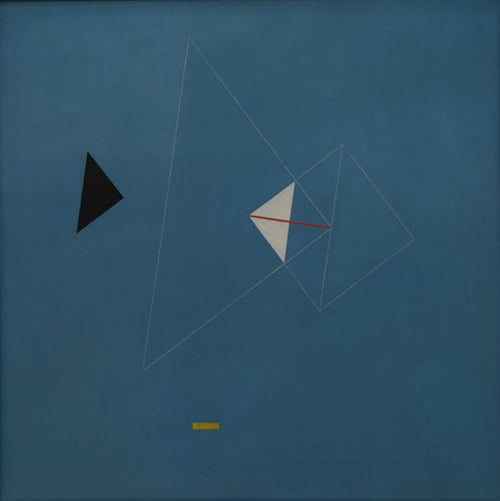
Analisi esperta di Composition No. 116 di Friedrich Vordemberge-Gildewart
Stile: Concretism · Genere: abstract
As an expert art historian, I offer the following analysis of "Composition No. 116" by Friedrich Vordemberge-Gildewart.
Significance and Context
This work stands as a quintessential example of Concretism, a movement that emerged in the early 20th century as a radical departure from abstract expressionism. Concretism demands that art be entirely self-contained—built from pure, logical, and mathematically precise elements (line, color, plane) without any reference to the natural world or symbolic meaning. Vordemberge-Gildewart was a pioneering member of this movement, and "Composition No. 116" embodies its core tenets.
Analysis of Form and Execution
The abstract composition is not a free-form improvisation but a rigorous, almost architectural exercise. The canvas is likely structured by a clean, orthogonal grid, with rectilinear shapes (squares, rectangles, and possibly vertical/horizontal bars) arranged in deliberate tension and balance. Colors—typically the three primaries (red, blue, yellow) along with black, white, and gray—are applied in flat, unmodulated planes, devoid of brushstroke texture or illusionistic depth.
What Makes It Significant
-
Reduction to Essentials: Vordemberge-Gildewart strips painting down to its most basic vocabulary: form and color as independent realities. There is no representation, no emotion, no narrative—only the concrete object of the painting itself.
-
Dynamic Equilibrium: Despite its static, geometric logic, "Composition No. 116" achieves a palpable sense of movement through asymmetrical balance. Lines and color blocks push and pull against the picture plane, creating a visual rhythm that is both orderly and alive.
-
Dialogue with Architecture and Design: Concretism, heavily influenced by the Bauhaus and De Stijl, saw art as part of a total environment. This work’s crisp geometry and modular thinking directly contributed to modern design, typography, and architecture—a legacy that underscores its importance.
-
Avant-Garde Purity: In the context of the 1920s–30s, when many artists were exploring psychological or expressive abstraction, Vordemberge-Gildewart’s fierce commitment to concrete (rather than abstracted-from-nature) forms was a radical statement. "Composition No. 116" is a testament to the belief that art must create its own reality, not imitate another.
In summary, this painting is significant for its rigorous application of Concretist principles, its role in bridging fine art and design, and its enduring influence on geometric abstraction. It is a masterclass in the power of pure, logical visual language.
Visivamente simili
20 opere con composizione e palette affini
Desarrollo del triángulo
Tomas Maldonado
Untitled Composition
Ilya Bolotowsky
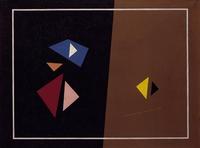
Composition No. 141
Friedrich Vordemberge-Gildewart
A 18
Laszlo Moholy-Nagy
Yellow Circle
Laszlo Moholy-Nagy
Untitled
Sandu Darie
Plakat für Ausstellung Baden-Baden
Johannes Itten
Utodia
Genis Remacha
Est Ouest 2
Richard Mortensen
Fantasia magia n.5
Galliano Mazzon
Structural Constellation 'To Ferdinand Hodler'
Josef Albers
Diamond Cut Series
Larry Zox
Chatel
Richard Mortensen
Peinture-relief
Marcelle Cahn
Komposition rotes Dreieck
Carl Buchheister
Color Perspective
Jacques Villon
Murailles de verre
Jean-Paul Jerome
Counter composition XIII
Theo van Doesburg
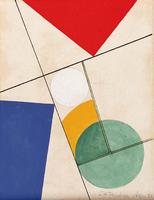
Composition
Sophie Taeuber-Arp
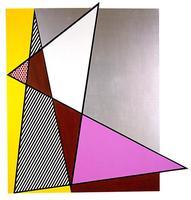
Imperfect painting
Roy Lichtenstein