
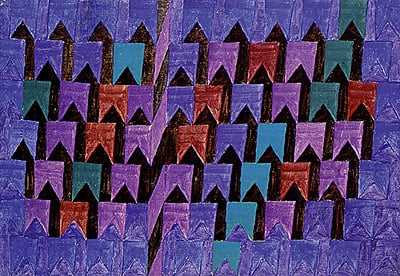
Bandeirinhas
Expertenanalyse zu Alfredo Volpis Bandeirinhas
Stil: Abstract Art, Naïve Art (Primitivism) · Genre: figurative
Expert Analysis of Alfredo Volpi’s "Bandeirinhas"
Alfredo Volpi’s Bandeirinhas (Portuguese for “little flags”) occupies a distinctive place in Brazilian modernism, where the boundaries between abstract geometry and naïve figuration blur into a uniquely rhythmic, celebratory visual language.
Stylistic Synthesis: Abstract Art meets Naïve Primitivism
Volpi is often described as a “naïve modernist.” His work synthesizes the formal concerns of European abstraction—flat planes, simplified forms, and a focus on color relationships—with the unpretentious, intuitive approach of naïve art. In Bandeirinhas, the flags are rendered as near-abstract triangles and rectangles, repeated in a frieze-like pattern that suggests both motion and festivity. Yet the subject remains recognizably figurative: these are the paper flags of Brazil’s June festivals (Festa Junina). This dual allegiance—to pure pictorial structure and to a humble, popular theme—is the key to Volpi’s significance.
Rhythm, Color, and Cultural Memory
What makes Bandeirinhas remarkable within its style is how Volpi transforms a folk decoration into a rigorous compositional motif. The flags form a syncopated pulse across the canvas, their alternating hues of blue, yellow, red, and white creating a chromatic rhythm that feels both spontaneous and controlled. This is not mere decoration; it is a meditation on repetition, variation, and the emotive power of color—hallmarks of mid-20th-century abstraction. At the same time, the naïveté of the forms keeps the painting grounded in a sense of childlike wonder and community celebration, distancing it from the intellectual austerity of geometric abstraction elsewhere.
Significance in Brazilian and Global Modernism
Volpi’s Bandeirinhas is significant as a bridge between high modernism and vernacular culture. In Brazil, where artists like Tarsila do Amaral and Cândido Portinari had already mined national identity, Volpi went further by elevating the most ephemeral of folk objects—paper flags strung on a string—to the status of a modern icon. Internationally, the work resonates with the Art Brut and Primitivist currents that valued raw, unacademic expression, but it does so without exoticizing its source. Instead, Volpi’s quiet, obsessive repetition of the flag motif prefigures the seriality of Pop and Minimalist art while retaining a warmth and human scale that is distinctly his own.
In Bandeirinhas, abstraction is not a rejection of reality but a distillation of joy. The painting’s genius lies in making the simplest of figurative subjects—a string of flags—feel monumental, serene, and alive.
Visuell ähnlich
20 Werke mit ähnlicher Komposition und Farbpalette
Bandeirinhas e Mastro
Alfredo Volpi
Bandeirinhas estruturadas
Alfredo Volpi
Bandeirinhas
Alfredo Volpi
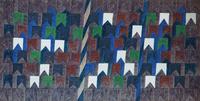
Bandeirinhas
Alfredo Volpi
Bandeirinhas com mastros e fitas
Alfredo Volpi
Bees
Henri Matisse
Composizione musicale
Galliano Mazzon
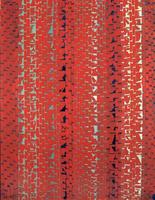
Red Sunset, Old Pond Concerto
Alma Woodsey Thomas

Estrutura Ambígua IV
Eduardo Nery
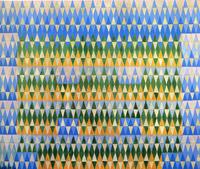
Iridescent Interpenetration No.5 - Eucalyptus
Giacomo Balla
Metamorphosis III excerpt 6
M.C. Escher
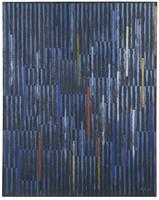
#137
Adolf Fleischmann
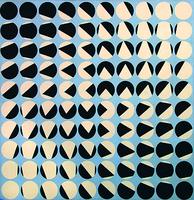
Progression
Horacio Garcia-Rossi
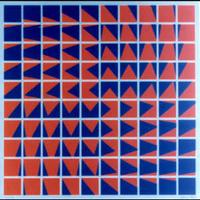
Untitled
Horacio Garcia-Rossi
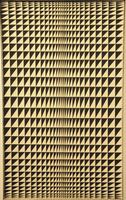
Concreção 8188
Luis Sacilotto
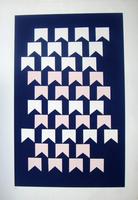
Bandeirinhas
Alfredo Volpi
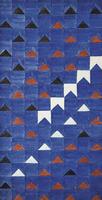
Bandeirinhas estruturadas
Alfredo Volpi

Honor Pythagoras, Per I--Per VI
Alfred Jensen
Sketch for a poster of the Vienna Workshop
Koloman Moser
#100
Adolf Fleischmann