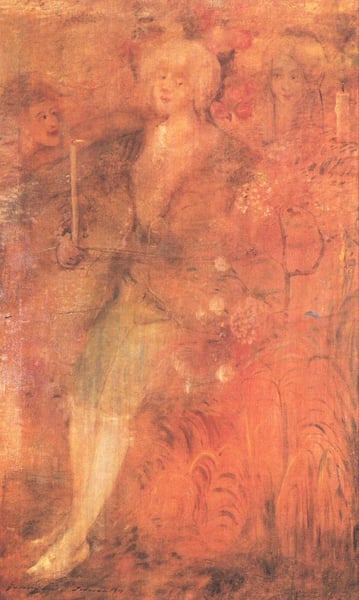
Analisi esperta di Chevalier aux Roses di Lajos Gulacsy
Stile: Symbolism · Genere: genre painting
The Chevalier aux Roses (Knight of the Roses) by Lajos Gulacsy stands as a quintessential example of Symbolist genre painting, distinguished by its dreamy, melancholic fusion of medieval reverie and personal mythology. Gulacsy, a Hungarian painter whose work often dwells in a twilight world of nostalgic fantasy, transforms the ordinary genre scene into a deeply poetic and subjective vision. The “knight” figure—likely a solitary, pensive wanderer amid roses—functions not as a historical portrait but as a symbol of chivalric longing and spiritual isolation. The rose itself, a classic Symbolist motif, may evoke beauty, transience, or unattainable love.
What makes this work significant within Symbolism is its immersive, otherworldly atmosphere. Gulacsy’s palette is typically soft, muted, and almost spectral, with a delicate handling of light that seems to emanate from an interior dreamscape. Here, genre painting is elevated to a vehicle for introspection: the everyday (a knight in a garden) is charged with emotional and symbolic weight, inviting the viewer into a private reverie. This piece also foreshadows Gulacsy’s later influence on Hungarian Surrealism, as his romanticized, slightly uncanny worlds occupy a liminal space between reality and imagination. Ultimately, Chevalier aux Roses exemplifies how Symbolist artists used allegory and mood to transcend literal narrative, creating a silent, haunting tableau that resonates with the viewer’s own subconscious desires.
Genere
Stile
Visivamente simili
20 opere con composizione e palette affini
Two women and a letter
J.M.W. Turner
Female Dancers
George Bouzianis
Spring (The Four Seasons)
Pierre-Auguste Renoir
La Cueva
Armando Reveron
Portrait of Madame Redon with Ari
Odilon Redon
Magic
Lajos Gulacsy
Woman's Portrait
Vladimir Tatlin
Study for Hyperion
George Frederick Watts
Head of a Young Woman
Pierre-Auguste Renoir
Women and Child
Pierre-Auguste Renoir
Portrait of a girl
Umberto Veruda
Le Coucher de Desdémone (Study?)
Theodore Chasseriau
Dancer with Castenets
Pierre-Auguste Renoir
Dancing Dryads
Albert Pinkham Ryder
Honourable Mary Baring, Later Marchioness Of Northampton
George Frederick Watts
Portrait of artist's family
Filipp Malyavin
The Mystical Knight (Oedipus and the Sphinx)
Odilon Redon
Study of a Woman
Pierre-Auguste Renoir
Grey and Pink, a Draped Model with Fan
James McNeill Whistler
The Alarm
George Harvey