Expertenanalyse zu Lajos Gulacsys Man with Hat and Woman with Black Scarf
Stil: Expressionism · Genre: genre painting
Expert Art Historical Analysis: Man with Hat and Woman with Black Scarf by Lajos Gulacsy
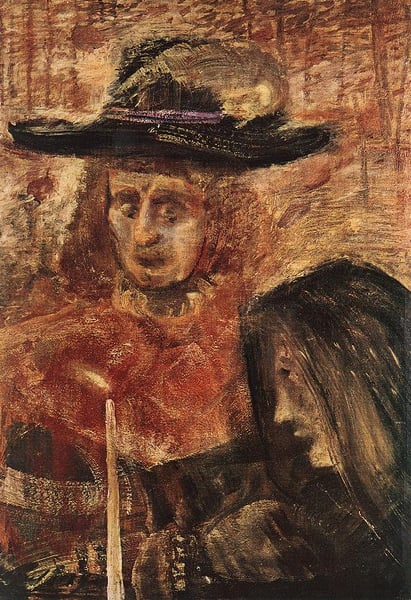
Lajos Gulacsy’s Man with Hat and Woman with Black Scarf stands as a compelling example of early 20th‑century Hungarian Expressionism that pushes beyond mere visual distortion into a deeply subjective, psychological realm. Though classified as a genre painting—a scene of everyday life—Gulacsy transforms the ordinary encounter into an emotionally charged, almost theatrical tableau.
Significance within Expressionism and Period Context:
The work’s significance lies in how Gulacsy melds the core tenets of Expressionism—heightened emotion, bold color, and distorted form—with a disquieting narrative stillness typical of his personal symbolism. The title itself draws attention to costume and accessories (the hat, the black scarf), which function not as neutral details but as signifiers of identity, mood, and perhaps isolation. In keeping with Expressionist practice, Gulacsy likely uses exaggerated contours, unnatural color relationships, and a flattened spatial composition to externalize the inner psychic state of the figures. The woman’s black scarf, in particular, introduces a note of mourning, secrecy, or melancholy—a common undercurrent in Gulacsy’s dreamlike, often angst‑ridden oeuvre.
As a genre painting, the work elevates a mundane interaction into a profound statement on human solitude and social unease. This aligns with the broader Expressionist ambition to strip away surface realism and reveal raw feeling. Gulacsy’s distinct contribution to the movement in Hungary is his fusion of this emotional intensity with a delicate, almost decadent painterly sensibility—reminiscent of his contemporaries like Csontváry or the European Symbolists—yet firmly rooted in the psychological tension of the Jazz Age. The painting thus acts as a bridge between late Romantic introspection and modern alienation, making it a significant artifact of Central European Expressionist genre imagery.
Genre
Stil
Visuell ähnlich
20 Werke mit ähnlicher Komposition und Farbpalette
Gogol and Pushkin
Oleg Holosiy
Hamlet and Ophelia
Mikhail Vrubel
Girls Smoking Cigarettes
Isaac Israels
Jeune femme de Paris
Jozsef Rippl-Ronai
Alisa Georgyevna Koonen
Georgy Yakulov
Portrait de sa Soeur
Theodule Ribot
Sorrow
Howard Pyle
Fellow Citizens
Corneliu Baba
Woman with candle and mantilla
Jose Mongrell
Woman Peeling Apple
Gerard Terborch
The Jewels
Edgar Degas
Woman with Flowers
Odilon Redon
Cabaret (Visul lui Omero)
Jules Perahim
Reverie
William Merritt Chase
Masquerade
Antoine Watteau
Madonna
Bela Czobel
Girl with Hat
Pierre-Auguste Renoir
The Monster
Odilon Redon
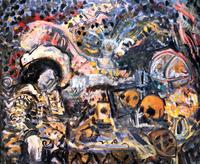
El sueno de Dona Marina 2
Alberto Gironella
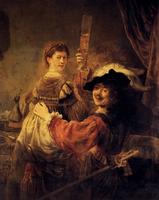
Self-Portrait with Saskia in the Parable of the Prodigal Son
Rembrandt