
Expert analysis of Rosalyn Drexler’s Love and Violence
Style: Pop Art · Genre: figurative
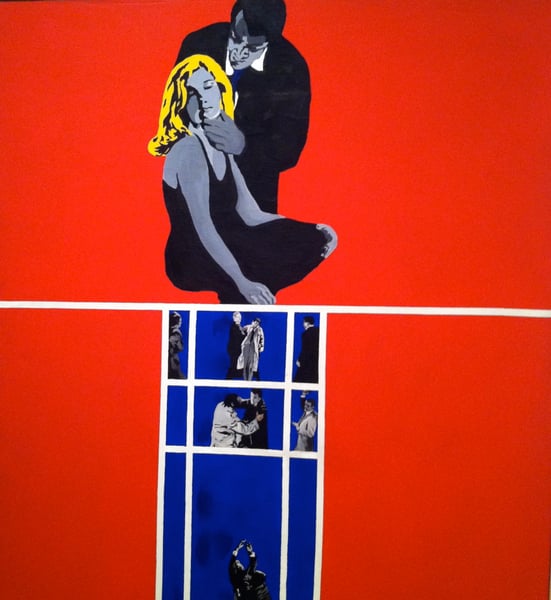
Rosalyn Drexler’s "Love and Violence" stands as a pointed, provocative intervention in the male-dominated landscape of 1960s Pop Art. While many Pop artists of the period celebrated or coolly observed consumer culture and mass media, Drexler injects a raw, feminist critique—often overlooked in standard Pop histories.
Composition and Imagery
True to the figurative genre, Drexler borrows from the visual language of tabloid headlines, B-movies, and pulp fiction. In Love and Violence, she typically juxtaposes symbols of romance (hearts, embraces, soft pastels) with stark acts of aggression or threat (shadowy figures, implied blows, or fractured bodies). The palette is deliberately flat and poster-like, drawing from the same commercial silk-screening that Andy Warhol used—but her brush is more gestural, less mechanical. The figures are often cropped and contorted, suggesting both intimacy and danger.
Significance within Pop Art
-
Gendered Critique – Drexler subverts Pop’s typical obsession with consumer commodities (soup cans, comic strips) by focusing instead on the commodification of the female body and domestic violence. Love and Violence directly confronts the hidden brutality that often lurks behind the idealized “romance” sold by mass media. In doing so, she expands Pop’s critical lens from consumerism to patriarchal power structures.
-
Narrative Juxtaposition – Unlike the serial, deadpan repetitions of Warhol or Lichtenstein’s Ben-Day dot romances, Drexler crafts tense, ambiguous scenes. The title itself is a contradiction that forces the viewer to ask: Are love and violence inseparable in our cultural imagination? This ambiguity—part melodrama, part reportage—gives the work a psychological depth rare in early Pop.
-
Feminist Pop Precedent – Drexler was among the first women to adopt Pop strategies for explicit social critique. Alongside contemporaries like Marisol Escobar or later artists such as Martha Rosler, she used accessible mass-media imagery to challenge the very systems that produced it. Love and Violence thus functions as a precursor to the postmodern feminist art of the 1970s.
Art-Historical Legacy
Though less commercially celebrated than her male peers, Drexler’s work is increasingly recognized for its prescient intersection of Pop’s visual wit with a serious moral and political charge. Love and Violence exemplifies how Pop Art could be more than a mirror of its time—it could be a weapon. The painting remains a vital example of how figurative Pop can unsettle as much as it entertains, using the very language of spectacle to expose its flaws.
Genre
Style
Visually similar
20 works with related composition and palette
Home Movies
Rosalyn Drexler
Lovers (a.k.a. Am I Faris)
Rosalyn Drexler
L'Assemblée Libre
Evelyne Axell
Chubby Checker
Rosalyn Drexler
Le Maquereau
Camille Bombois
Man Woman
Allen Jones
This Is My Wedding
Rosalyn Drexler
Judy Garland and Liza Minnelli
Andy Warhol
Night Geometry
Jack Vettriano
Marilyn Pursued By Death
Rosalyn Drexler
Yellow Harlows Poster
Jerry W. McDaniel
Game Of Power
Jack Vettriano
IMG 1926
Ramiro Martín Martín
Advertisment for "Norine"
Rene Magritte
Jealousy
Laszlo Moholy-Nagy
Great American Nude
Tom Wesselmann
When the Going Is Smooth and Good
Njideka Akunyili Crosby
Betrayal First Kiss 2001
Jack Vettriano
Time for Bed
Eric Fischl
Jitterbugs (III)
William H. Johnson