
Análisis experto de L'Assemblée Libre de Evelyne Axell
Estilo: Pop Art · Género: figurative
Expert Analysis: "L'Assemblée Libre" by Evelyne Axell (1965–1970)
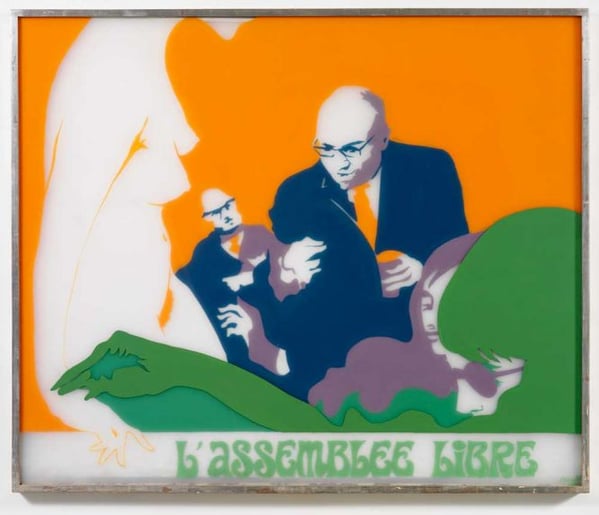
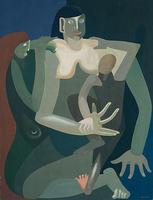
Evelyne Axell’s L’Assemblée Libre is a defining work of European Pop Art that simultaneously celebrates and subverts the movement’s signature visual language. As one of the few prominent female artists in a male-dominated Pop sphere, Axell infused the style’s bold graphics, flat color planes, and mass-media references with a distinctly feminist and erotic sensibility.
Significance within Pop Art:
While American and British Pop often depicted women as passive consumer icons (e.g., Warhol’s Marilyn, Lichtenstein’s distressed heroines), Axell reclaims the female figure as an agent of desire and liberation. The title—The Free Assembly—suggests a collective, empowered presence, likely a group of women who are self-possessed rather than objectified. The work’s figurative composition uses Pop’s characteristic hard edges, high-contrast outlines, and vibrant, unmodulated colors (often with surreal, candy-like hues) to create a dreamlike yet confrontational space.
Technical and Thematic Innovations:
Axell frequently worked on Plexiglas or with glossy enamel paints, giving her surfaces a slick, “plastic” sheen that mirrors Pop’s fascination with contemporary consumer culture. In L’Assemblée Libre, this technique would enhance the figures’ graphic intensity, blurring the line between painting and sign. Her women are active, often masked or fragmented in ways that allude to both pleasure and the constraints of feminine roles. The “free assembly” may depict a joyful gathering, yet the stylized forms also hint at the performance of identity—a key theme in Axell’s output.
Cultural and Historical Context:
Created in the late 1960s, during the rise of second-wave feminism and the sexual revolution, the work stands as a bold rejoinder to the male gaze. Axell drew on sources ranging from comic strips to Vogue advertisements, but she repurposed them to visualize women’s desire—a radical move within Pop. Her background as an actress and filmmaker further informs the theatrical, posed quality of her figures, invoking a sense of agency: these women are performing freedom.
Legacy:
L’Assemblée Libre exemplifies Axell’s ability to merge Pop’s accessibility with a proto-feminist critique, making her a crucial—if long overlooked—link between Pop Art, Surrealism, and the political art of the 1970s. The work’s celebratory yet unsettling energy remains vital, asserting that the “assembly” of liberated bodies is not merely a spectacle but a declaration of sovereignty.
Género
Estilo
Visualmente similares
20 obras con composición y paleta relacionadas
Group Therapy
Evelyne Axell
Le Dejeuner sur l'Herbe (after Manet)
Paul Wunderlich
Señor presidente, qué honor estar con usted en este momento histórico
Beatriz González
Scheiber Hugó, Bonviván 1922
Scheiber Hugó
Lo schiaffo
Mario Comensoli
(Constantine) Guys
Red Grooms
The Miracle
Julia Soboleva
L'Abstraction, Le Peintre et le Modele
Jean Helion
Portrait of Tristan Tzara
Lajos Tihanyi
Love in the Green Room
Rosalyn Drexler
Untitled
Richard Lindner
Remake
Jean Helion
Couple with Leslie
Neil Welliver
Painter and Modell
Ernst Ludwig Kirchner
Love and Violence
Rosalyn Drexler
Scheiber Hugó, Könyöklő Csvargó
Scheiber Hugó
The Defenders
Rosalyn Drexler
Great Lovers (Mr and Miss Hembus)
Ernst Ludwig Kirchner
Advertisment for "Norine"
Rene Magritte
Maternity
Amedee Ozenfant