
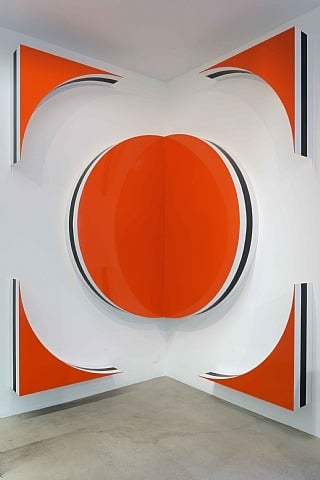
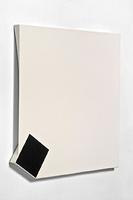
Photo-souvenir: 1 carré = 1 cercle + 4 triangles, Hauts-reliefs situés H, travail situé
Dettagli
Analisi esperta di Photo-souvenir: 1 carré = 1 cercle + 4 triangles, Hauts-reliefs situés H, travail situé di Daniel Buren
Stile: Minimalism · Genere: installation
This artwork by Daniel Buren, a key figure in post-minimalist and conceptual art, is significant for its radical redefinition of sculpture and its relationship to the site it occupies. The title itself—"Photo-souvenir: 1 carré = 1 cercle + 4 triangles, Hauts-reliefs situés H, travail situé"—encapsulates the work’s core principles: geometry, documentation, and site-specificity.
Geometric Deconstruction and Minimalist Language:
The equation "1 square = 1 circle + 4 triangles" suggests a theoretical transformation of basic geometric forms. This echoes Minimalism’s fascination with primary shapes and reduction to essential structures. However, Buren goes beyond a mere formal exercise by physically realizing these forms as “hauts-reliefs” (high-reliefs), pushing them into architectural space. The interplay of a square (the resulting composition) derived from a circle and four triangles demonstrates a logical, almost algebraic method of shaping material—a hallmark of Buren’s analytical approach.
Site-Specificity and “Travail Situé”:
The phrase “travail situé” (situated work) is central to Buren’s practice. Unlike traditional sculptures that are autonomous objects, this installation is defined by its location—here, the letter “H” likely refers to a specific site (perhaps a building or gallery space). Buren’s reliefs are not portable masterpieces; they are interventions within a given environment, engaging with the walls, floors, or architectural details. This challenges Minimalism’s earlier notion of the object as self-contained and instead foregrounds the context as an integral part of the artwork’s meaning.
The Role of Documentation (“Photo-souvenir”):
Calling the work a “photo-souvenir” underscores that the physical installation is ephemeral, intended to be experienced in situ and subsequently remembered through photographic documentation. This aligns with Buren’s broader critique of the art market and the commodification of art objects. The photograph becomes not a mere reproduction but an essential component of the work’s identity, emphasizing that the artwork exists primarily as an event or encounter in time and space.
Significance within Minimalism and Beyond:
Buren’s piece extends Minimalism’s legacy by shifting focus from the object to the system—a system of perception, geometry, and place. The equal sign in the title implies a conceptual equivalence that is tested through physical materials. This work thus stands as a pivotal example of how Minimalist principles (simplicity, repetition, industrial materials) can be transformed into a critique of the institutional and spatial frameworks that art inhabits. It is significant precisely because it makes the location, the viewer’s movement, and the act of remembrance part of the aesthetic experience.
Visivamente simili
20 opere con composizione e palette affini
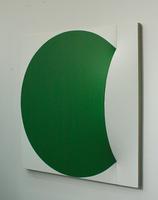
Closing the Gap Once (green)
Jan Maarten Voskuil
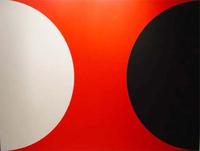
Omega IX
Alexander Liberman
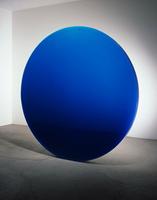
Circle Blue
De Wain Valentine
Shapin' Up
Leo Valledor
P 1210, Halbkreis
Gottfried Honegger
Untitled
Robert Irwin
Four Color Frame Painting #5 (Parasol Unit)
Robert Mangold
Greenstone
Walter Darby Bannard
Three Panels. Orange, Dark Gray, Green
Ellsworth Kelly
Untitled
Rodolfo Arico
Orange Relief with Green
Ellsworth Kelly
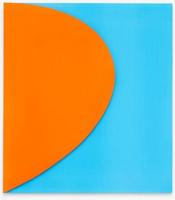
Orange Relief with Blue
Ellsworth Kelly
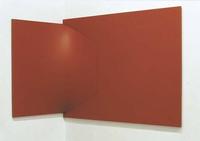
Dittico rosso
Enrico Castellani
The Elders
Walter Darby Bannard
Yellow Rose #1
Walter Darby Bannard
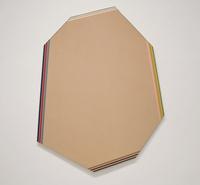
Rich Rhythm
Kenneth Noland
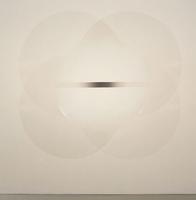
Untitled
Robert Irwin
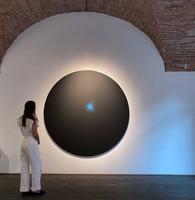
Mantra 59
Armen Agop
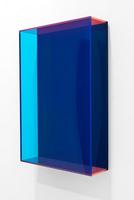
Colormirror Maisach Blue
Regine Schumann
The Whim of Tituba
Tony DeLap