Analisi esperta di De profundis di Endre Balint
Stile: Surrealism · Genere: symbolic painting
Expert Art Historical Analysis: "De profundis" by Endre Balint
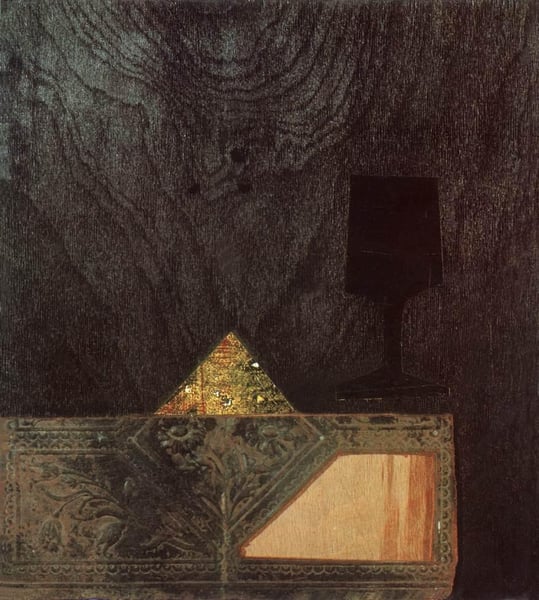
Endre Balint’s "De profundis" (Latin for “Out of the depths”) is a compelling example of mid-20th-century Hungarian Surrealism, a movement that often channeled collective trauma and personal introspection through symbolic, dreamlike imagery. The work belongs to the genre of symbolic painting, which in the Surrealist context transcends mere representation to become a visual language for the subconscious.
Significance within Surrealism and Symbolic Painting:
Balint’s painting derives its power from a tense union of Surrealistic automatism and iconographic precision. While Surrealism famously explored the irrational, Balint’s approach here is notably controlled, using deliberate symbols to evoke a psychological descent and the struggle for emergence—a theme directly signaled by the title’s reference to Psalm 130. This makes the work significant as a bridge between earlier, more flamboyant Surrealist experimentation and the introspective, existential concerns of post-war European art.
Key analytical aspects:
-
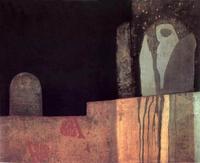
Title as conceptual core: "De profundis" anchors the painting in a tradition of spiritual crisis. The depths are not merely physical or literal but represent a state of despair, memory, or the subconscious. Balint transforms this cry into a visual phenomenon, likely employing a dark, muted palette with stark contrasts—typical of his style—to create an atmosphere of melancholy and latent tension.
-
Surrealist transformation of the human figure: In line with Surrealism’s fascination with distorted anatomy, Balint often presents figures as fragmented or hybridized. In this work, one might expect a lone, elongated or faceless figure emerging from a shadowy void, or biomorphic forms suggestive of both birth and burial. This ambiguity allows the painting to function simultaneously as a self-portrait of the artist’s psyche and a universal symbol of existential struggle.
-
Symbolic space: The composition likely collapses interior and exterior spaces—a room, a landscape, or a dreamscape—using perspectival dislocation. Objects (such as a window, a mirror, a ladder, or organic growths) may appear out of scale or context, each carrying layered symbolic weight (e.g., the ladder as ascent from the depths, or a mirror as self-confrontation). This technique places "De profundis" within the lineage of Surrealist symbolic painting pioneered by artists like Max Ernst and Yves Tanguy, but with a distinctively Hungarian emphasis on psychological realism.
-
Cultural and historical resonance: Painted during a period of political upheaval in Eastern Europe, Balint’s work often reflects a deep sense of alienation and the search for meaning under oppressive regimes. "De profundis" can be read as a metaphorical cry for liberation—both personal and collective—making it significant not only as an art object but as a document of its time.
Conclusion: "De profundis" is significant because it demonstrates how Surrealism could move beyond shock and automatism to serve a meditative, symbolic purpose. Balint’s mastery lies in his ability to render the ineffable—the depths of the psyche—with formal rigor and emotional weight. The painting stands as a poignant exemplar of Hungarian Surrealism’s unique contribution to the broader movement: a poetry of silence, darkness, and the fragile possibility of rising again.
Genere
Stile
Visivamente simili
20 opere con composizione e palette affini
THE LIFE OF THE SOUTHERN SKY (side view)
Leonid Sejka
THE LIFE OF THE SOUTHERN SKY (side view)
Leonid Sejka
Station Without a Stop. Kunzevo.
Kazimir Malevich
Il Secchio Sospeso
Mario Tozzi
Untitled
Albert Rafols-Casamada
Still Life with White Tablecloth
Juan Gris
Statue in a Cemetery
Endre Balint
The Glass
Juan Gris
La composizione TA
Carlo Carra
Japanese Picture
Bertalan Por
Forme e Piani
Mario Tozzi
The Packet of Coffee
Juan Gris
The buffet of 'Catalan'
Pablo Picasso
Esperit de Kamil
Modest Cuixart
Guitar, Bottle and Glass
Juan Gris
Windy Room
Lech Jankowski
Untitled
Nasreen Mohamedi
Soba na dohvat vulkana
Leonid Šejka
Untitled (The Great Masturbator Appears Behind Arcades)
Salvador Dali
Bálint Endre, Ablak Feszülettel
Endre Balint